LLM News Digest

AI Agents Cross Production Thresholds

April 6, 2026 · 12 papers

This week showcases AI systems crossing critical capability thresholds, from agents completing eight-year development projects in three months to security researchers reporting a dramatic quality leap in AI-generated vulnerability reports. We explore practical challenges like managing AI-friendly codebases, security considerations for AI-generated code execution, and the emerging tension between AI-accelerated development and traditional software engineering discipline.

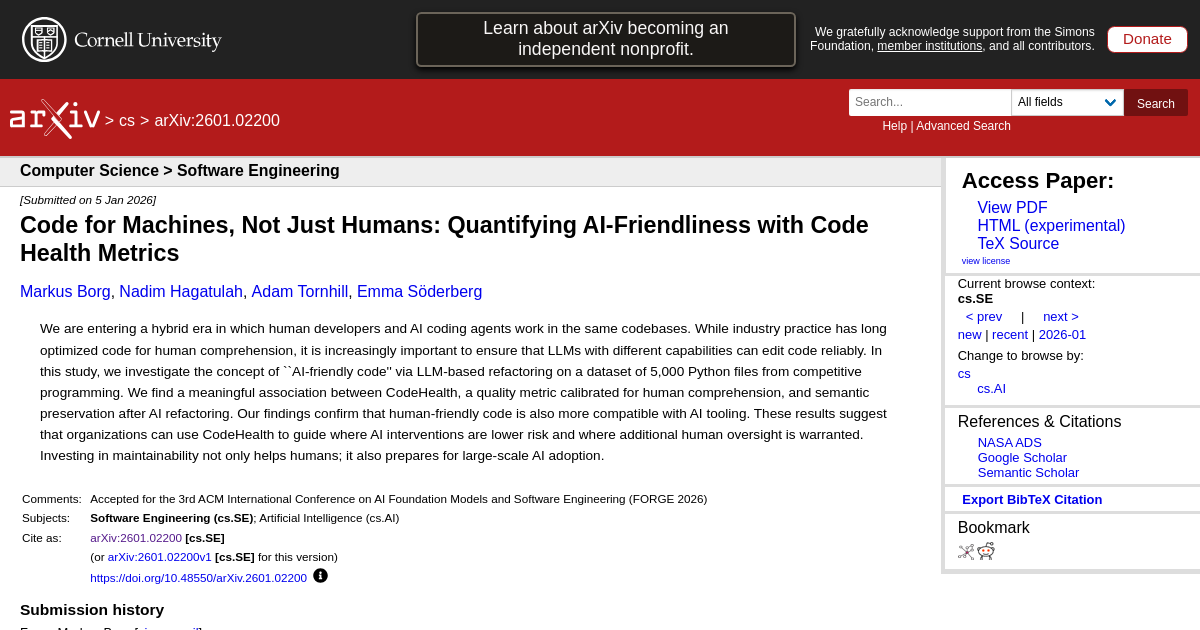
Code for Machines, Not Just Humans: Quantifying AI-Friendliness with Code Health Metrics
Accessible

Code for Machines, Not Just Humans: Quantifying AI-Friendliness with Code Health Metrics

This research challenges the assumption that AI coding tools work equally well on all codebases by showing that existing code quality metrics predict how reliably LLMs can refactor code without breaking it. Teams can use metrics like CodeHealth to identify where AI assistance is safer to deploy and where human oversight is critical. Essential reading for engineering leaders planning AI tool rollouts — it turns out investing in code maintainability isn't just about helping humans, it's about preparing your codebase for AI.

Takeaways
  • Human-friendly code quality metrics like CodeHealth strongly correlate with AI refactoring success rates.
  • Teams can proactively identify high-risk areas for AI intervention using existing code quality tools.
  • Investing in code maintainability pays dividends for both human developers and AI tooling effectiveness.
via manual
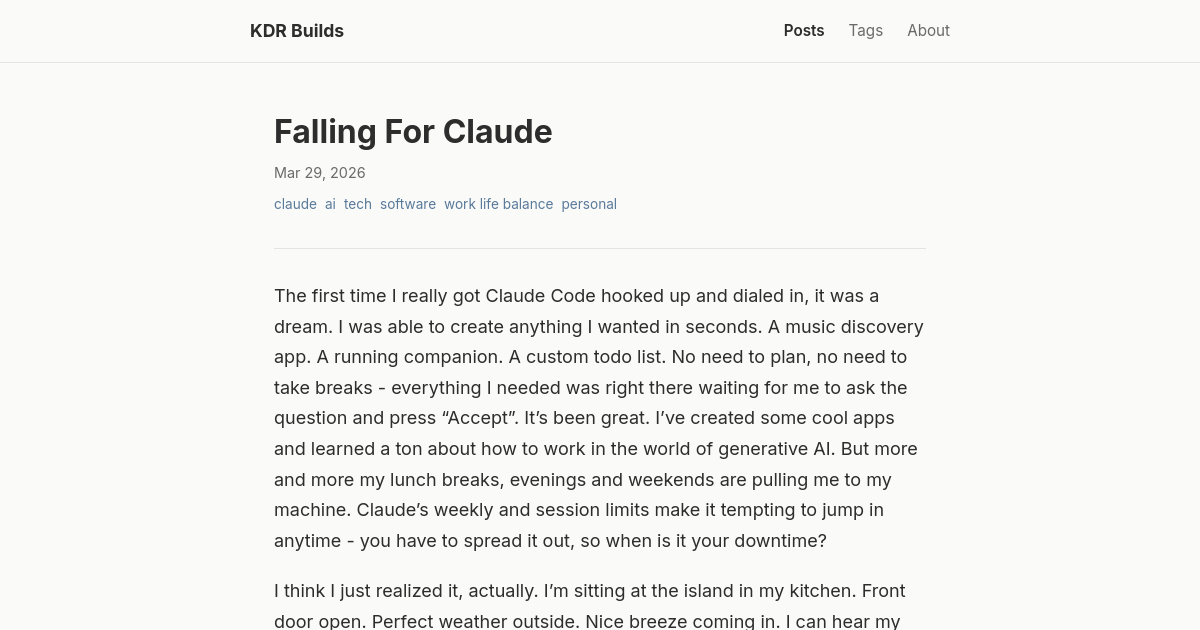
Falling For Claude
Accessible

Falling For Claude

A candid reflection on how always-available AI coding assistants like Claude can blur work-life boundaries in unexpected ways. The author explores the psychological and practical implications of having a tireless coding companion that makes it tempting to work at all hours. Important perspective for engineers and managers thinking about sustainable AI adoption practices.

Takeaways
  • AI coding assistants can create unhealthy work patterns by making development feel frictionless at any time.
  • The always-available nature of AI tools requires intentional boundaries to maintain work-life balance.
via manual
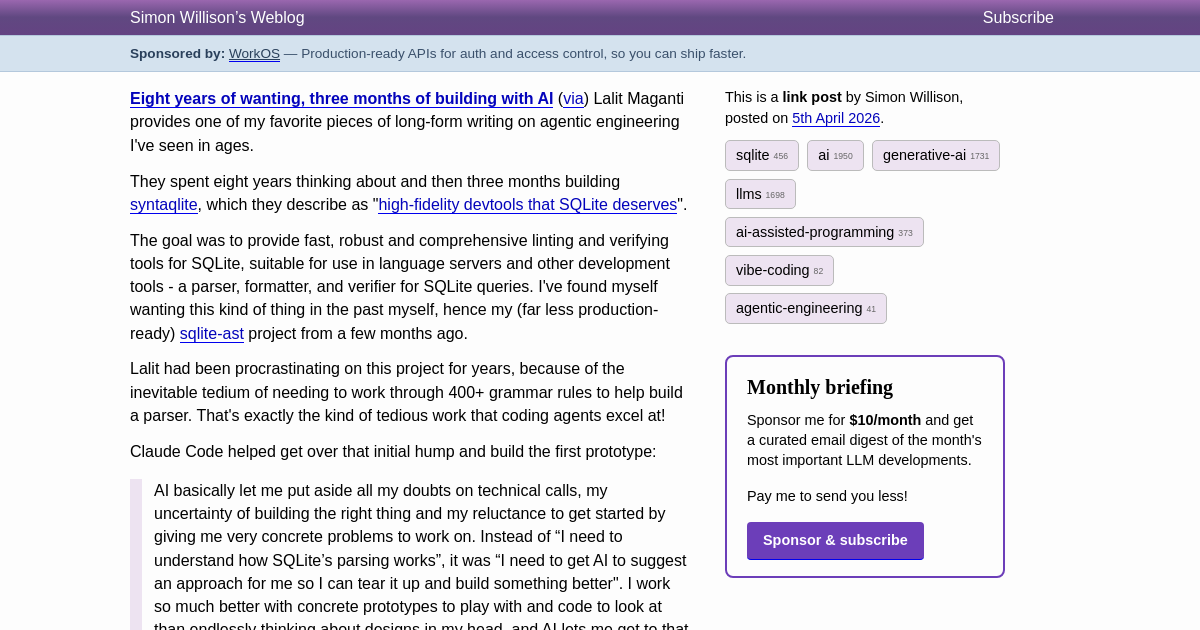
Eight years of wanting, three months of building with AI
Intermediate

Eight years of wanting, three months of building with AI

A compelling case study of how AI agents transformed an eight-year software vision into reality in just three months, specifically building comprehensive SQLite development tools. The author provides detailed insights into agentic engineering workflows and how AI can tackle complex, long-deferred projects that seemed too daunting for traditional development approaches. This demonstrates the paradigm shift from AI as a coding assistant to AI as a capable engineering partner.

Takeaways
  • AI agents can make previously intractable personal projects suddenly feasible by handling complex implementation details.
  • Agentic engineering workflows enable rapid prototyping of sophisticated developer tools that would take months using traditional methods.
  • The key to successful AI-assisted development is clearly defining goals while letting agents handle implementation complexity.
via rss-willison
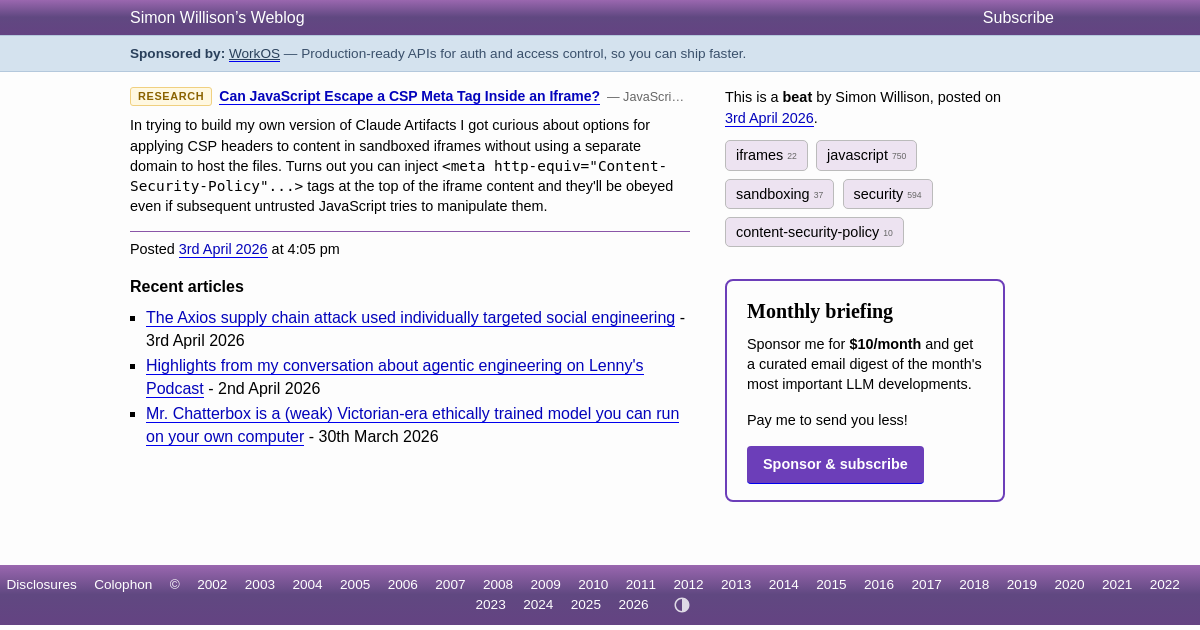
Can JavaScript Escape a CSP Meta Tag Inside an Iframe?
Intermediate

Can JavaScript Escape a CSP Meta Tag Inside an Iframe?

Practical security research motivated by building Claude Artifacts-style features, investigating whether Content Security Policy meta tags can effectively sandbox JavaScript in iframes without requiring separate domains. The findings show that CSP meta tags injected at the top of iframe content remain effective even against subsequent JavaScript manipulation attempts. Directly actionable for engineers building AI applications that execute user-generated or AI-generated code.

Takeaways
  • CSP meta tags in iframe content provide effective sandboxing without requiring separate domains for hosting.
  • JavaScript cannot manipulate CSP restrictions that were set via meta tags earlier in the document.
  • This technique enables safer execution of AI-generated code in web applications.
via rss-willison
Tell HN: Anthropic no longer allowing Claude Code subscriptions to use OpenClaw
Accessible

Tell HN: Anthropic no longer allowing Claude Code subscriptions to use OpenClaw

firloop

Anthropic's policy change affecting third-party tools like OpenClaw represents a significant shift in how developers can access Claude's capabilities outside official interfaces. This impacts teams that have built workflows around unofficial Claude integrations and highlights the business risks of depending on third-party API access patterns. Important for understanding the evolving landscape of AI tool accessibility.

Takeaways
  • Third-party Claude integrations now require separate pay-as-you-go billing beyond subscription limits.
  • Teams using unofficial Claude tools need to evaluate cost implications and migration strategies.
  • The change reflects tightening control over AI model access as these tools become more strategically important.
1079 points on HN · via api-hn
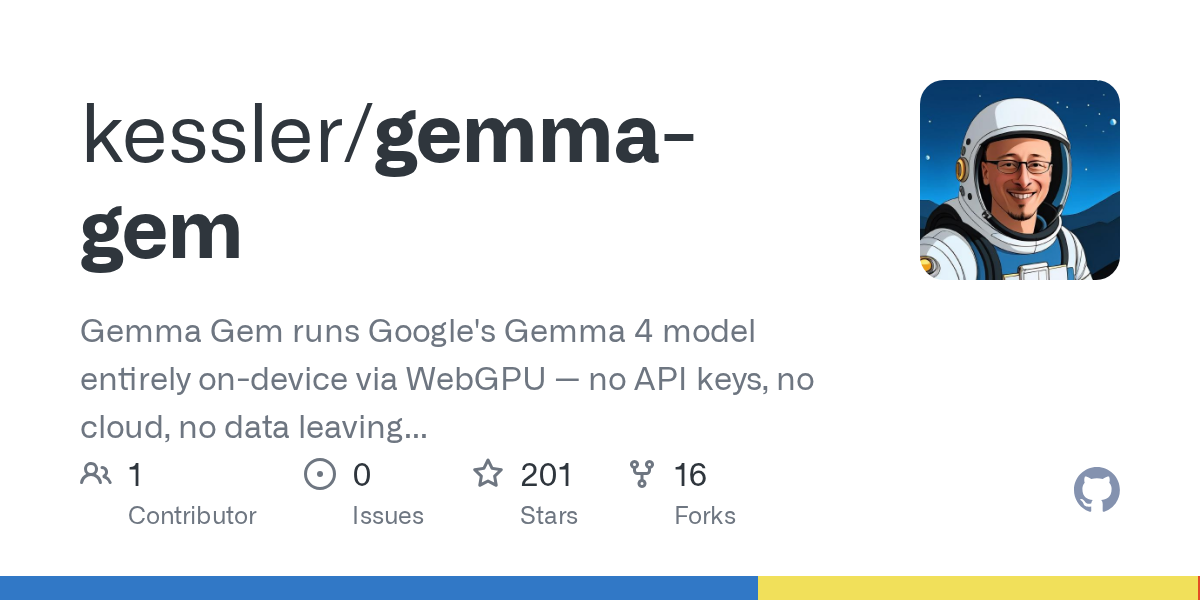
Show HN: Gemma Gem – AI model embedded in a browser – no API keys, no cloud
Intermediate

Show HN: Gemma Gem – AI model embedded in a browser – no API keys, no cloud

ikessler

This Chrome extension demonstrates practical browser-based AI deployment by embedding Google's Gemma 4 model locally via WebGPU, complete with webpage interaction capabilities like clicking, typing, and JavaScript execution. It proves that sophisticated AI agents can run entirely client-side without API dependencies, opening new possibilities for privacy-preserving AI tools. The implementation shows how to build truly local AI agents with real-world utility.

Takeaways
  • WebGPU enables running 2B parameter models entirely in the browser without cloud dependencies.
  • Local AI agents can interact with web pages through tool calling while preserving user privacy.
  • Browser-based AI deployment eliminates API costs and latency while maintaining reasonable functionality.
100 points on HN · via api-hn
The Design of AI Memory Systems
Intermediate

The Design of AI Memory Systems

Unable to provide detailed description due to missing content, but AI memory systems design is crucial for building production agents and RAG applications that need to maintain context and learn from interactions.

7 points on Lobsters · via api-lobsters
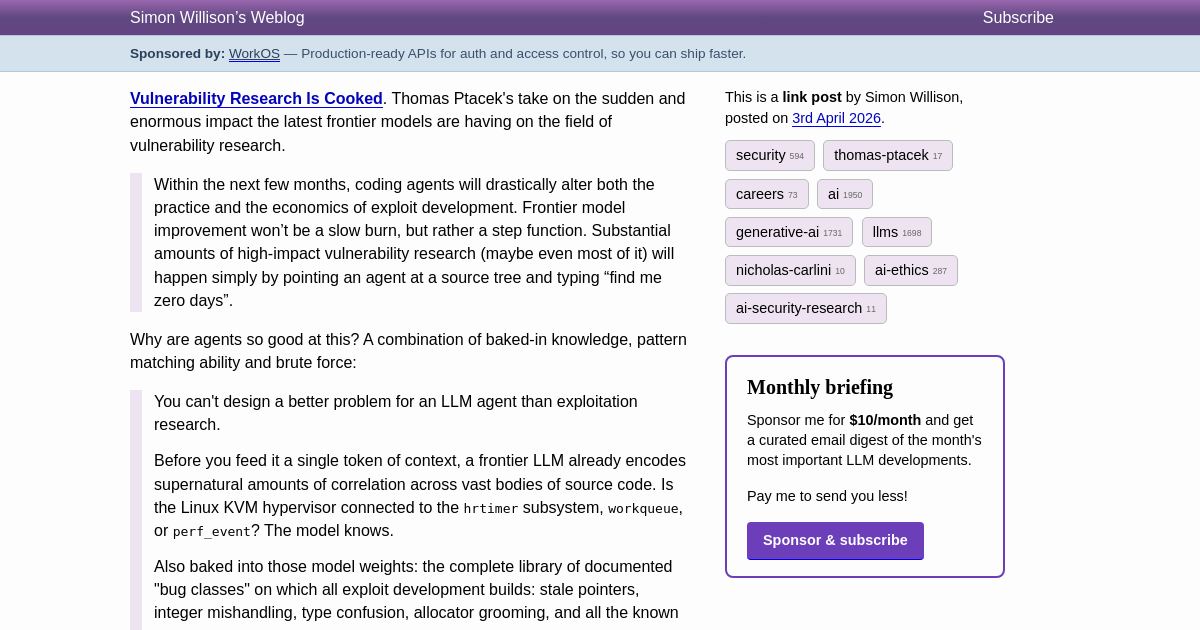
Vulnerability Research Is Cooked
Intermediate

Vulnerability Research Is Cooked

Thomas Ptacek's analysis of how frontier models are fundamentally disrupting vulnerability research, arguing that AI agents will soon automate most exploit development work. He predicts this won't be gradual improvement but a sudden step-function change that transforms both the economics and practice of security research. Essential reading for understanding how AI is reshaping cybersecurity beyond just coding assistance.

Takeaways
  • Frontier AI models will automate vulnerability discovery by systematically analyzing codebases at scale.
  • The transformation will be sudden rather than gradual, fundamentally altering security research economics.
  • Most high-impact vulnerability research may soon require only pointing agents at source code rather than manual analysis.
via rss-willison
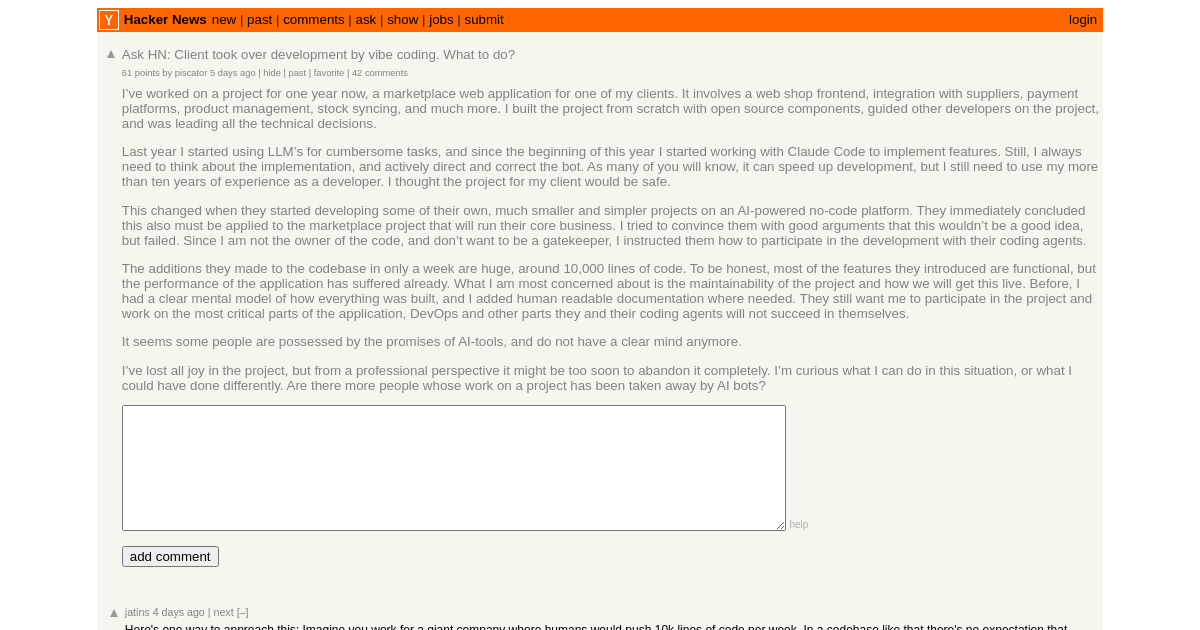
Ask HN: Client took over development by vibe coding. What to do?
Accessible

Ask HN: Client took over development by vibe coding. What to do?

piscator

A developer's experience with a client who embraced "vibe coding" with Claude Code, making rapid changes without proper planning or architecture consideration. This highlights the tension between AI-enabled development speed and traditional software engineering discipline, raising important questions about maintaining code quality and project management when AI makes coding feel effortless.

Takeaways
  • AI coding tools can enable rapid development that bypasses important planning and architecture phases.
  • "Vibe coding" with AI can create technical debt and project management challenges despite apparent productivity gains.
  • Professional development workflows need to adapt to balance AI speed with engineering discipline.
61 points on HN · via api-hn
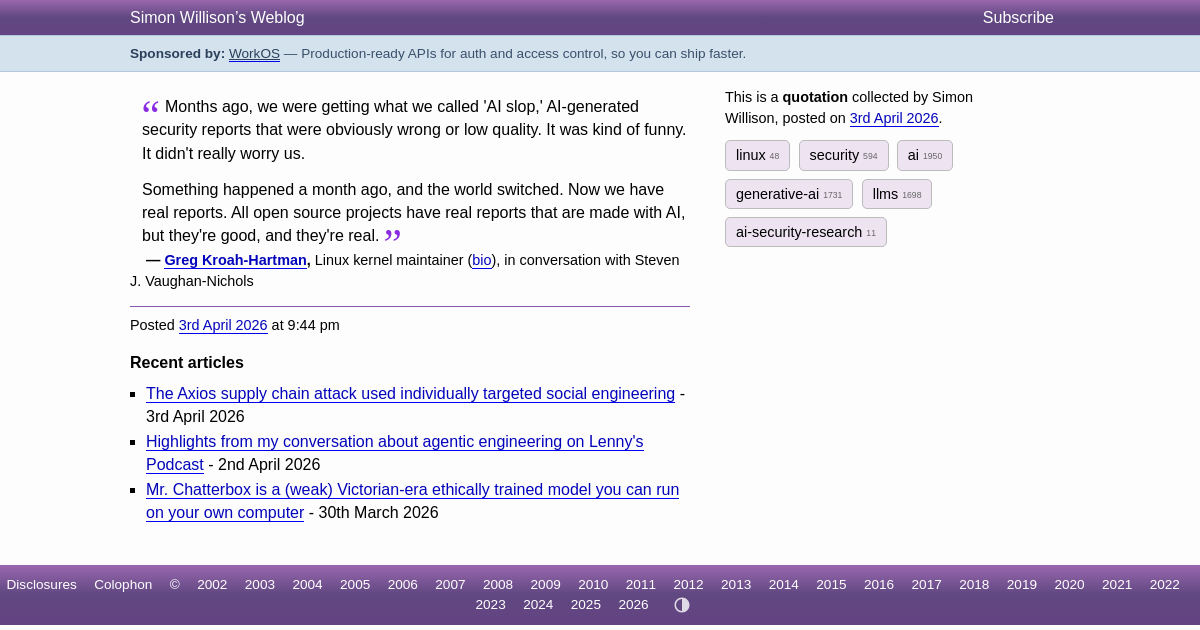
Quoting Greg Kroah-Hartman
Accessible

Quoting Greg Kroah-Hartman

Greg Kroah-Hartman, Linux kernel maintainer, describes a dramatic shift in AI-generated security reports from obvious "slop" to genuinely valuable contributions in just one month. This represents a critical inflection point where AI tools have crossed the threshold from nuisance to legitimate assistance in security research. The timing and scale of this change suggests we're witnessing a fundamental capability leap in AI security tooling.

Takeaways
  • AI-generated security reports have rapidly evolved from low-quality noise to genuinely valuable contributions.
  • The transformation happened suddenly rather than gradually, suggesting a capability threshold was crossed.
  • Open source maintainers are now receiving quality AI-assisted security research that requires serious attention.
via rss-willison
Moonlake: Causal World Models should be Multimodal, Interactive, and Efficient — with Chris Manning and Fan-yun Sun
Advanced

Moonlake: Causal World Models should be Multimodal, Interactive, and Efficient — with Chris Manning and Fan-yun Sun

Stanford researchers discuss Moonlake, their approach to building causal world models that understand multimodal interactions and can efficiently reason about cause and effect in complex environments. This foundational research explores how AI systems can develop better understanding of how the world works, which is crucial for building more capable agents that can plan and reason about their actions.

Takeaways
  • Causal world models enable AI systems to understand cause-and-effect relationships rather than just correlations.
  • Multimodal approaches help models build more comprehensive understanding of how actions affect environments.
  • Efficient world models are essential for practical agent deployment in real-world scenarios.
via rss-latentspace