LLM News Digest

Agent Evaluation Advances, Security Gets Serious

April 13, 2026 · 12 papers

This week brings critical infrastructure advances for AI systems in production, with new frameworks for evaluating agent capabilities and safety (Claw-Eval, ClawsBench), alongside breakthrough security research including Anthropic's restricted Claude Mythos release and formal verification approaches using theorem proving. The edition also covers practical engineering insights on scaling LLM systems to billions of tokens daily and novel training techniques that help models simulate their own code execution.

From Technical Debt to Cognitive and Intent Debt: Rethinking Software Health in the Age of AI
Accessible

From Technical Debt to Cognitive and Intent Debt: Rethinking Software Health in the Age of AI

As teams increasingly rely on AI to accelerate development, this framework warns that we're accumulating dangerous new forms of debt beyond just technical debt. Cognitive debt occurs when teams lose shared understanding of their systems as AI generates code faster than they can comprehend it, while intent debt refers to the missing documentation of why decisions were made—critical context that both humans and AI agents need to safely evolve code. This triple debt model provides a essential lens for evaluating software health in the AI era.

Takeaways
  • Cognitive debt erodes team understanding as AI generates code faster than teams can internalize it, creating dangerous knowledge gaps.
  • Intent debt—missing rationale and constraints—becomes critical when AI agents need explicit context to safely modify code.
  • Traditional technical debt metrics miss these human and knowledge-based risks that dominate in AI-assisted development.
via manual
Components of A Coding Agent
Intermediate

Components of A Coding Agent

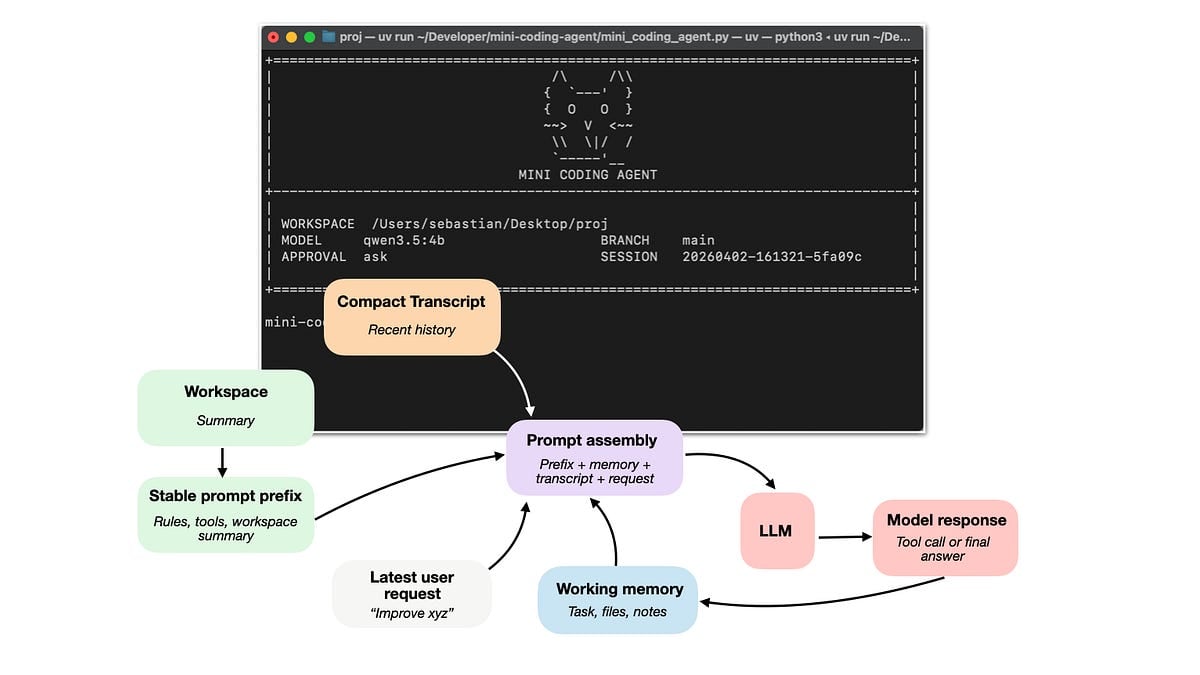
Essential reading if you're architecting coding agents for production use. This breaks down the core components that make LLMs effective at code generation: sophisticated tool integration, persistent memory systems that maintain context across interactions, and repository-aware context management that helps models understand large codebases. The practical focus on how these pieces work together makes this invaluable for teams moving beyond simple code completion to full coding assistance.

Takeaways
  • Effective coding agents require sophisticated tool integration beyond simple code completion.
  • Memory systems that persist context across sessions are crucial for maintaining coherent development workflows.
  • Repository-aware context management enables agents to understand and work with large, complex codebases.
via manual
Embarrassingly Simple Self-Distillation Improves Code Generation
Intermediate

Embarrassingly Simple Self-Distillation Improves Code Generation

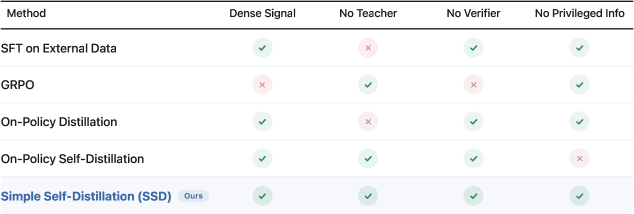
This challenges the conventional wisdom that you need external verification or teacher models to improve code generation—instead, models can learn from their own outputs using simple self-distillation. The technique improved a 30B model's performance from 42% to 55% on challenging coding problems by sampling solutions at specific temperatures and fine-tuning on them. The key insight is that this reshapes how models balance precision versus exploration in a context-dependent way, making it a practical post-training technique for enhancing coding assistants.

Takeaways
  • Models can significantly improve at code generation using only their own outputs, without external verification or teacher models.
  • Simple self-distillation resolves the precision-exploration conflict by context-dependently reshaping token distributions.
  • The technique shows consistent gains across model sizes and families, making it broadly applicable for improving coding assistants.
via manual
Claw-Eval: Toward Trustworthy Evaluation of Autonomous Agents
Intermediate

Claw-Eval: Toward Trustworthy Evaluation of Autonomous Agents

Bowen Ye, Rang Li, Qibin Yang, Yuanxin Liu, Linli Yao, Hanglong Lv, Zhihui Xie, Chenxin An, Lei Li, Lingpeng Kong, Qi Liu, Zhifang Sui, Tong Yang

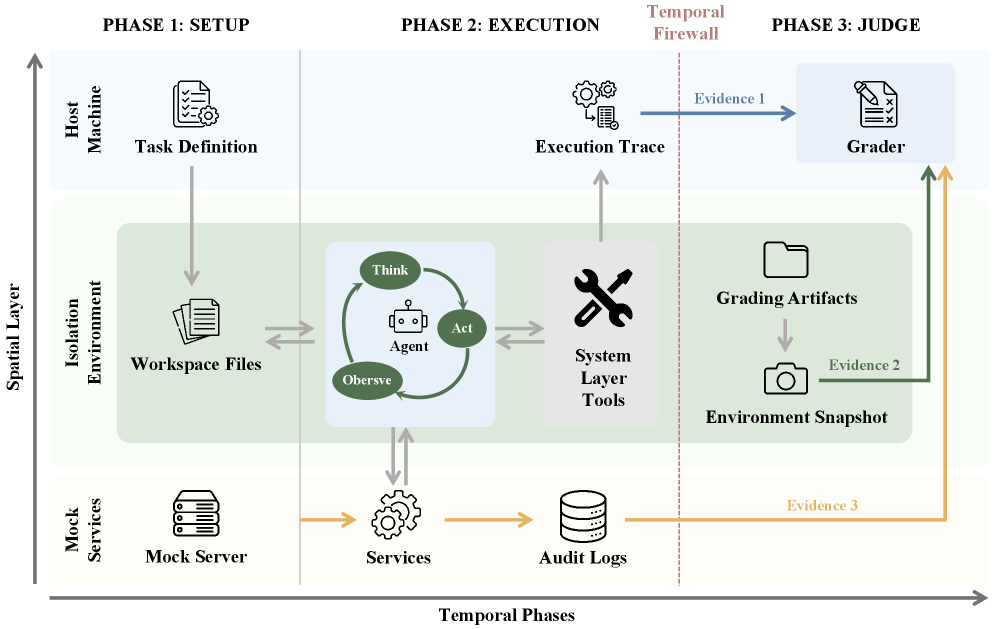
Current agent benchmarks are dangerously inadequate for production deployment because they only check final outputs without understanding how agents got there, and they barely evaluate safety or robustness. Claw-Eval fixes this with 300 real-world tasks that record every agent action through execution traces, audit logs, and environment snapshots, enabling fine-grained evaluation across completion, safety, and robustness dimensions. This comprehensive approach is essential for teams serious about deploying autonomous agents in high-stakes environments.

Takeaways
  • Current agent evaluation methods are inadequate for production use because they ignore the decision-making process and safety concerns.
  • Comprehensive evaluation requires tracking every agent action through multiple evidence channels, not just final outputs.
  • Real production deployment demands measuring completion, safety, and robustness across multiple trials with fine-grained rubrics.
via api-hf · arXiv:2604.06132
ClawsBench: Evaluating Capability and Safety of LLM Productivity Agents in Simulated Workspaces
Accessible

ClawsBench: Evaluating Capability and Safety of LLM Productivity Agents in Simulated Workspaces

Xiangyi Li, Kyoung Whan Choe, Yimin Liu, Xiaokun Chen, Chujun Tao, Bingran You, Wenbo Chen, Zonglin Di, Jiankai Sun, Shenghan Zheng, Jiajun Bao, Yuanli Wang, Weixiang Yan, Yiyuan Li, Han-chung Lee

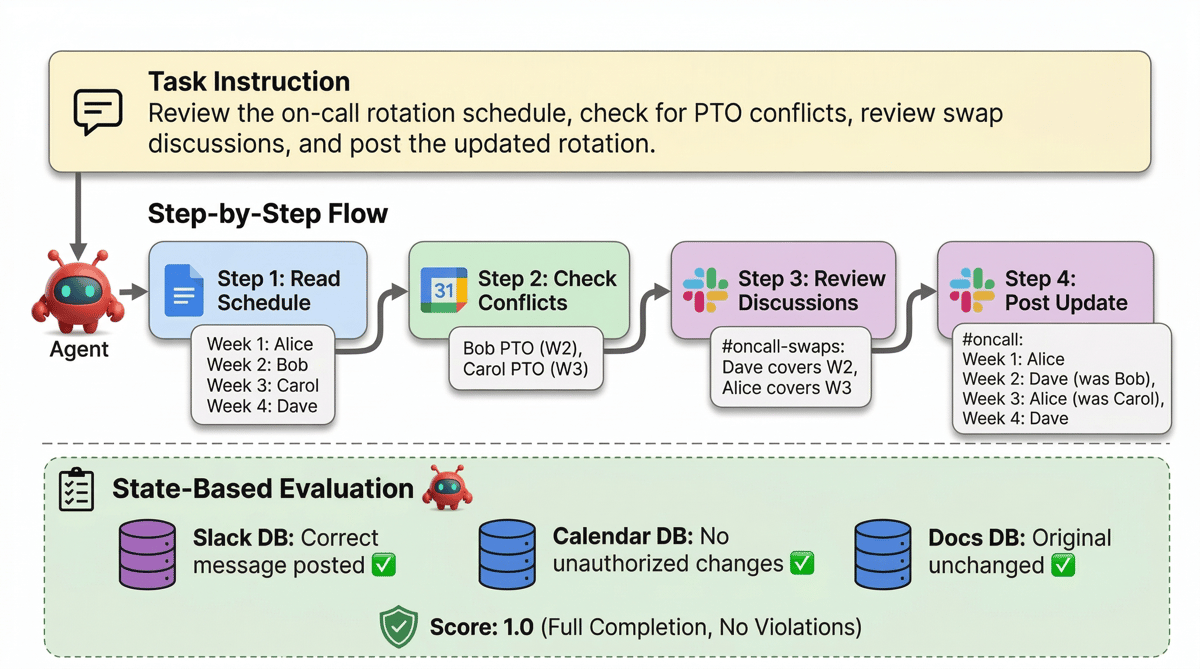
Testing agents on live productivity services is too risky, but existing benchmarks don't capture the complexity of real workflows across Gmail, Slack, and Google services. ClawsBench solves this with high-fidelity mock services that maintain full state and support deterministic snapshot/restore, enabling safe evaluation of 44 structured tasks including dangerous scenarios. The research reveals that domain skills (API knowledge injection) and meta prompts (cross-service coordination) are independent levers that teams can optimize separately for better agent performance.

Takeaways
  • High-fidelity simulation environments with full state management enable safe evaluation of agents in realistic productivity scenarios.
  • Domain skills and meta prompts are independent architectural components that can be optimized separately for better agent performance.
  • Safety-critical scenarios must be explicitly tested since agents can cause irreversible damage in productivity environments.
via api-hf · arXiv:2604.05172
Type-Checked Compliance: Deterministic Guardrails for Agentic Financial Systems Using Lean 4 Theorem Proving
Intermediate

Type-Checked Compliance: Deterministic Guardrails for Agentic Financial Systems Using Lean 4 Theorem Proving

Devakh Rashie, Veda Rashi

Financial services face an existential problem: probabilistic LLMs operating in domains requiring absolute compliance guarantees, and existing guardrails are fundamentally inadequate for complex regulatory constraints. This paper presents a breakthrough using Lean 4 theorem proving to treat every AI action as a mathematical conjecture—execution only proceeds if the system can formally prove regulatory compliance. While the approach targets financial services, the formal verification framework could revolutionize how we build deterministic guardrails for any high-stakes AI system.

Takeaways
  • Probabilistic guardrails are fundamentally inadequate for regulated industries that demand mathematical certainty of compliance.
  • Formal theorem proving can provide deterministic guarantees by treating every AI action as a provable mathematical conjecture.
  • Auto-formalizing policies into verifiable code bridges the gap between human regulations and machine-enforceable constraints.
0 citations · via api-hf · arXiv:2604.01483
Extreme Harness Engineering for Token Billionaires: 1M LOC, 1B toks/day, 0% human code, 0% human review — Ryan Lopopolo, OpenAI Frontier & Symphony
Intermediate

Extreme Harness Engineering for Token Billionaires: 1M LOC, 1B toks/day, 0% human code, 0% human review — Ryan Lopopolo, OpenAI Frontier & Symphony

Move over prompt engineering—harness engineering is the new frontier for building production LLM systems at massive scale. This deep dive from OpenAI's Ryan Lopopolo reveals how teams operating at token-billionaire scale (1B tokens/day) architect systems with millions of lines of code generated without human review. The focus shifts from optimizing individual prompts to engineering the entire infrastructure that channels LLM capabilities into reliable, scalable production systems.

Takeaways
  • At massive scale, engineering the infrastructure around LLMs matters more than optimizing individual prompts.
  • Production systems generating millions of lines of code daily require fundamentally different architectural approaches.
  • Token billionaire scale operations demand new engineering disciplines focused on harness systems rather than model tuning.
via rss-latentspace
ACES: Who Tests the Tests? Leave-One-Out AUC Consistency for Code Generation
Intermediate

ACES: Who Tests the Tests? Leave-One-Out AUC Consistency for Code Generation

Hui Sun, Yun-Ji Zhang, Zheng Xie, Ren-Biao Liu, Yali Du, Xin-Ye Li, Ming Li

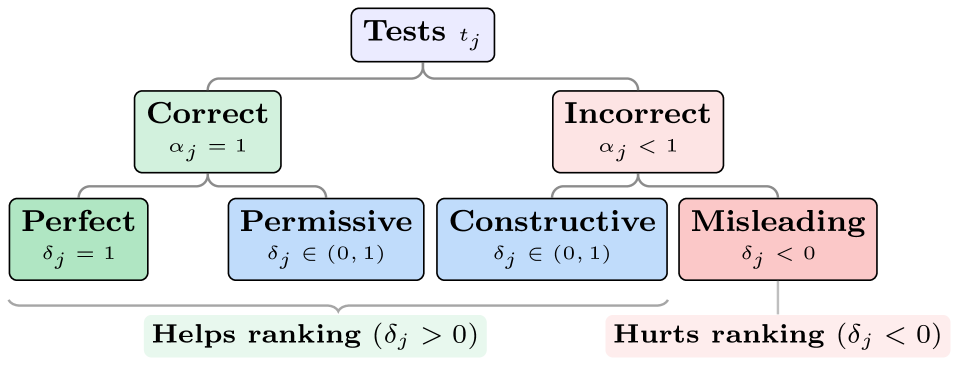
When LLMs generate both code and tests, how do you evaluate test quality without knowing which code is correct? This paper breaks the circular dependency with a clever insight: tests should rank code quality, not just count passes, and you can measure ranking ability through leave-one-out evaluation. The approach measures whether each test's pass/fail pattern correlates with how other tests collectively rank the code, providing a principled way to weight unreliable LLM-generated tests without needing ground truth.

Takeaways
  • Test evaluation should focus on ranking ability rather than simple pass/fail counting when both code and tests are LLM-generated.
  • Leave-one-out AUC breaks the circular dependency between code correctness and test reliability without requiring ground truth.
  • Tests that better distinguish correct from incorrect code deserve more weight in aggregate evaluation schemes.
via api-hf · arXiv:2604.03922
Neural Computers
Intermediate

Neural Computers

Mingchen Zhuge, Changsheng Zhao, Haozhe Liu, Zijian Zhou, Shuming Liu, Wenyi Wang, Ernie Chang, Gael Le Lan, Junjie Fei, Wenxuan Zhang, Yasheng Sun, Zhipeng Cai, Zechun Liu, Yunyang Xiong, Yining Yang, Yuandong Tian, Yangyang Shi, Vikas Chandra, Jürgen Schmidhuber

This proposes a radical paradigm shift where models don't just generate code or control external systems—they become the execution environment itself, unifying computation, memory, and I/O in learned runtime state. Neural Computers learn to execute programs by watching I/O traces and can potentially be reprogrammed through natural language rather than traditional coding. While early-stage, this vision could fundamentally reshape how we build AI systems by eliminating the boundary between model and runtime environment.

Takeaways
  • Neural Computers eliminate the distinction between model and execution environment by making the model itself the running computer.
  • Early implementations can learn interface primitives and basic execution patterns from I/O traces alone.
  • This paradigm shift could enable natural language reprogramming of computational systems without traditional coding interfaces.
via api-hf · arXiv:2604.06425
Anthropic's Project Glasswing - restricting Claude Mythos to security researchers - sounds necessary to me
Intermediate

Anthropic's Project Glasswing - restricting Claude Mythos to security researchers - sounds necessary to me

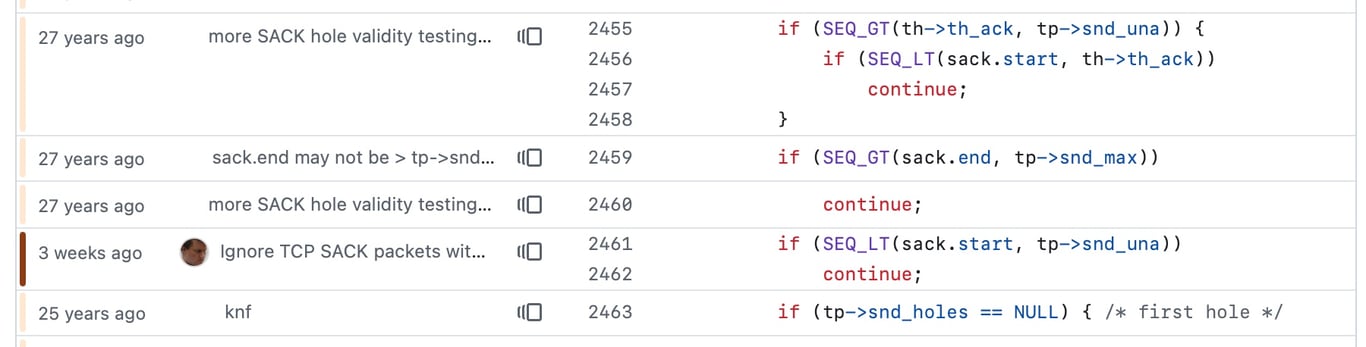
Anthropic took the unprecedented step of restricting access to Claude Mythos because its cybersecurity research capabilities are too powerful for general release—the model has already found thousands of high-severity vulnerabilities. This sets a crucial precedent for responsible AI deployment and signals that we're entering an era where model capabilities may outpace our ability to deploy them safely. Security-conscious engineering teams should pay close attention to how this restricted release model evolves.

Takeaways
  • AI capabilities in cybersecurity research have reached levels requiring restricted deployment to prevent misuse.
  • Anthropic's Mythos demonstrates that responsible AI release may require industry-wide coordination and preparation time.
  • The precedent of capability-based access restrictions signals a new phase in AI safety and deployment practices.
via rss-willison
Self-Execution Simulation Improves Coding Models
Intermediate

Self-Execution Simulation Improves Coding Models

Gallil Maimon, Ori Yoran, Felix Kreuk, Michael Hassid, Gal Cohen, Pierre Chambon, Yossi Adi

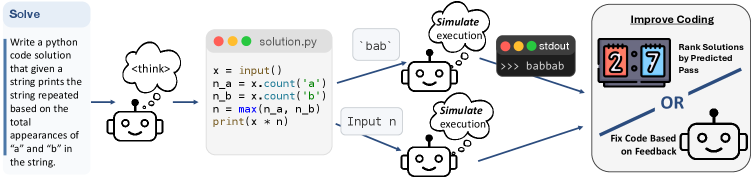
Code LLMs struggle because they can't accurately predict what their generated code will do when executed, leading to logical errors that escape syntax checking. This research trains models to simulate program execution step-by-step, enabling self-verification and iterative debugging of their own code. The approach combines supervised learning on execution traces with reinforcement learning, achieving significant improvements on competitive programming benchmarks and providing a foundation for more reliable AI coding assistants.

Takeaways
  • Teaching models to simulate execution enables self-verification and iterative debugging of generated code.
  • Combining execution simulation training with reinforcement learning significantly improves competitive programming performance.
  • Step-by-step execution traces provide grounding that helps models understand and debug their logical reasoning in code.
via api-hf · arXiv:2604.03253
Large Language Models Generate Harmful Content Using a Distinct, Unified Mechanism
Advanced

Large Language Models Generate Harmful Content Using a Distinct, Unified Mechanism

Hadas Orgad, Boyi Wei, Kaden Zheng, Martin Wattenberg, Peter Henderson, Seraphina Goldfarb-Tarrant, Yonatan Belinkov

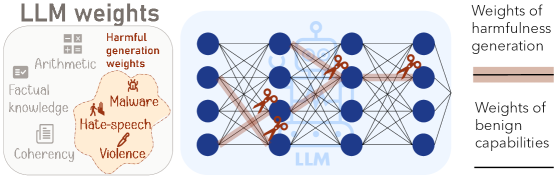
This research reveals that harmful content generation in LLMs depends on a surprisingly compact and unified set of weights that are distinct from benign capabilities—essentially, there's a discrete 'harm circuit' that can be surgically identified and removed. Alignment training compresses rather than eliminates these harmful capabilities, explaining why fine-tuning on narrow domains can cause 'emergent misalignment' and why jailbreaks remain effective despite safety training. These findings provide crucial insights for building more robust safety mechanisms in production systems.

Takeaways
  • Harmful capabilities in LLMs are encoded in compact, unified weight sets that are distinct from benign capabilities.
  • Alignment training compresses harmful representations rather than eliminating them, explaining the brittleness of safety guardrails.
  • Fine-tuning can reactivate compressed harmful capabilities, causing emergent misalignment across unrelated domains.
via api-hf · arXiv:2604.09544