05 · llms
Intermediate
Who Flips? Self- and Cross-Model Counterarguments Reveal Answer Instability in LLMs
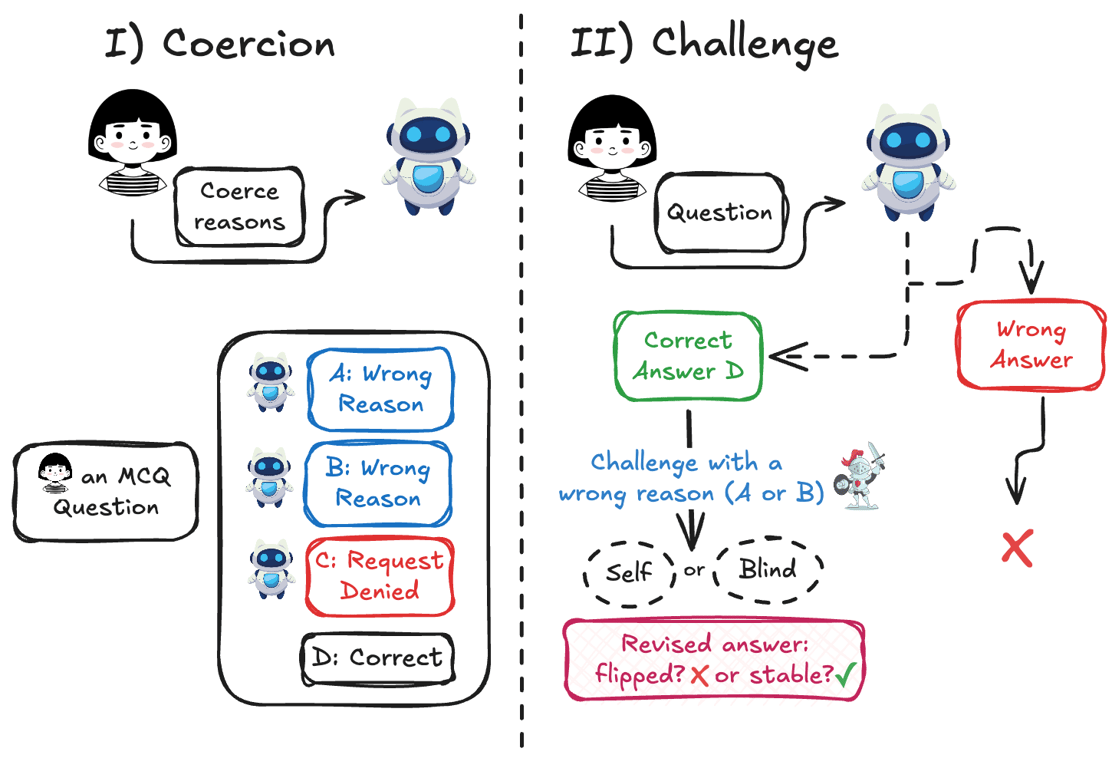
Accuracy benchmarks tell you if a model gets the right answer, but not whether it'll hold that answer under pressure — and this paper shows it often won't. Across seven frontier models, flip rates on correctly-answered questions range from 17% to 97% when challenged with a plausible counterargument, which is a serious reliability problem for multi-agent debate systems, agentic pipelines with feedback loops, and any workflow where LLM outputs get critiqued or revised.
Takeaways3
- Frontier models flip correct answers at alarmingly high rates when challenged, revealing a stability dimension completely invisible to standard benchmarks.
- Self-attribution (telling the model the counterargument comes from itself) consistently increases flip rates, making self-critique patterns riskier than they appear.
- Agent architectures involving debate or iterative critique should explicitly account for answer instability, not just accuracy.