LLM News Digest

Agents Leak, Judges Mislead, Reasoning Has Limits

June 29, 2026 · 11 papers

This week's edition is heavy on findings that should make you skeptical of assumptions baked into common agent architectures. On the safety side, 11 of 15 frontier agents leak private data at alarming rates, prompt injection is reframed as a structural role-boundary problem, and extended thinking turns out to be a poor safety mechanism. On the evaluation side, two papers challenge the reliability of LLM-as-a-judge pipelines—models attend to context 3-5x less when judging than generating, and a new human-grounded dataset exposes where automated judges actually fail. Rounding out the edition: a concrete production gotcha with tool calling and structured output on open-weight models, a cost-reduction framework for multi-tier model serving, and a principled look at the architectural limits of chain-of-thought reasoning.

Capable but Careless: Do Computer-Use Agents Follow Contextual Integrity?
Intermediate

Capable but Careless: Do Computer-Use Agents Follow Contextual Integrity?

Anmol Goel, Iryna Gurevych

If you're deploying computer-use agents that touch email, calendars, or personal apps, this should alarm you: 11 of 15 frontier agents leak private information in more than 50% of test scenarios, with an average leakage rate of 67.9%. The paper introduces AgentCIBench and names three specific failure modes—pulling in visually adjacent data, over-sharing on ambiguous prompts, and sending content to wrong recipients—giving you a concrete taxonomy to test against before shipping.

Takeaways
  • Most frontier computer-use agents will leak private context across application boundaries more often than not.
  • Three distinct failure modes (visual co-location, task-ambiguity overshare, recipient misalignment) should be explicitly tested in any agent privacy audit.
  • Cross-application context leakage is a systemic architectural problem, not a model-specific quirk.
via api-hf · arXiv:2606.23189
Constraint Tax in Open-Weight LLMs: An Empirical Study of Tool Calling Suppression Under Structured Output Constraints
Intermediate

Constraint Tax in Open-Weight LLMs: An Empirical Study of Tool Calling Suppression Under Structured Output Constraints

Fangzheng Li, Aimin Zhang, Chen Lv

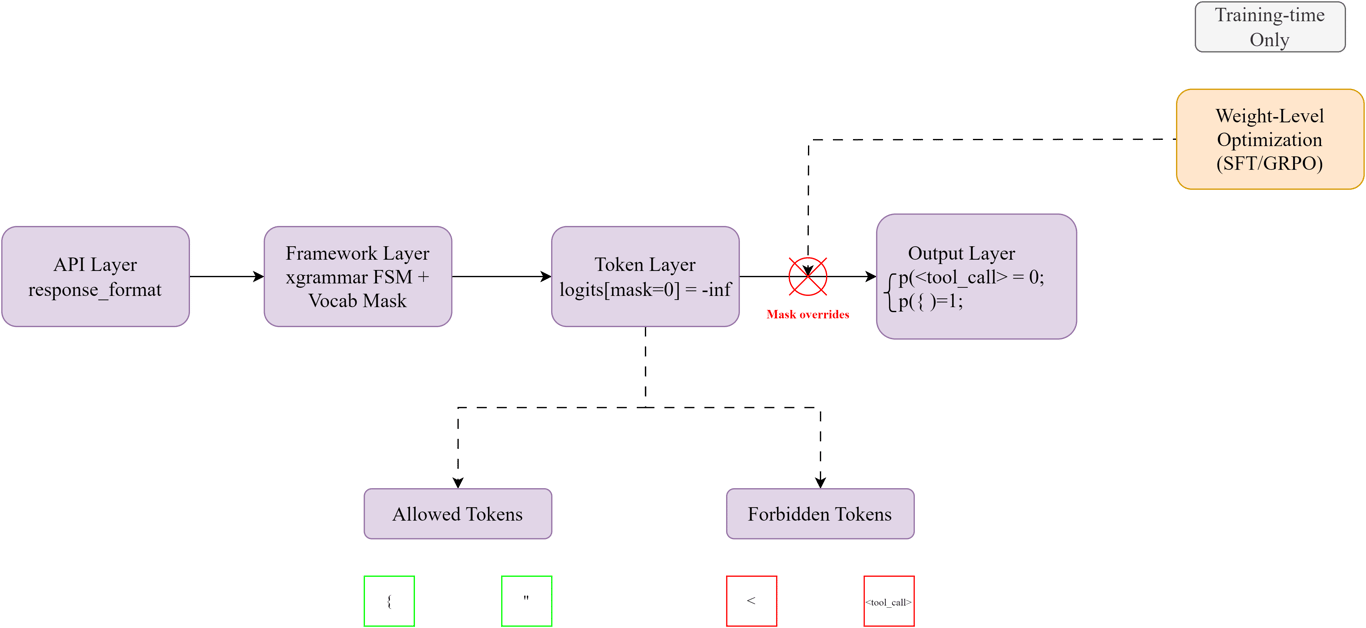
This paper documents a nasty production gotcha: enabling both tool calling and JSON Schema structured output simultaneously on many open-weight models causes the model to silently stop calling tools, even though both features work fine in isolation. The root cause is that grammar-based token masking for JSON Schema literally makes tool-call tokens unreachable during decoding—not a training issue, a decoding implementation issue. If you're building agents with structured output on open-weight models and wondering why tools aren't firing, this is why.

Takeaways
  • Simultaneously enabling structured output constraints and tool calling can silently suppress tool invocation in many open-weight models.
  • The failure stems from grammar-based token masking during decoding, not from model capability or fine-tuning.
  • Always test tool calling and structured output jointly in integration tests, not just independently.
0 citations · via api-hf · arXiv:2606.25605
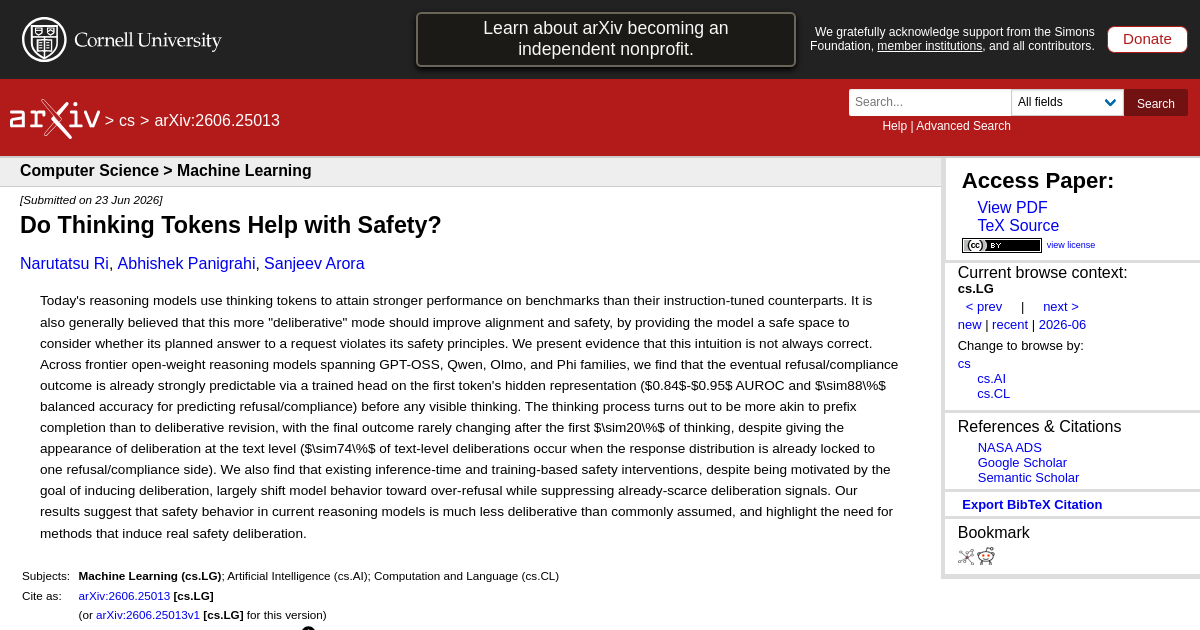
Do Thinking Tokens Help with Safety?
Intermediate

Do Thinking Tokens Help with Safety?

Narutatsu Ri, Abhishek Panigrahi, Sanjeev Arora

The intuition that 'thinking tokens give models time to reconsider unsafe outputs' turns out to be largely wrong. Across multiple reasoning model families, the final refusal-or-comply decision is already predictable with 88%+ accuracy from the very first token's hidden state—before any visible reasoning appears. The thinking text looks deliberative but mostly functions as prefix completion, with outcomes rarely changing after the first 20% of the chain-of-thought. This means you shouldn't rely on extended thinking as a safety mechanism.

Takeaways
  • Reasoning models' safety outcomes are effectively decided before thinking begins, not during it.
  • Thinking tokens provide the appearance of deliberation but rarely cause the model to reverse its initial safety disposition.
  • Safety architecture for reasoning models needs to address pre-thinking biases, not just the visible chain-of-thought.
via api-hf · arXiv:2606.25013
Are We Ready For An Agent-Native Memory System?
Intermediate

Are We Ready For An Agent-Native Memory System?

Wei Zhou, Xuanhe Zhou, Shaokun Han, Hongming Xu, Guoliang Li, Zhiyu Li, Feiyu Xiong, Fan Wu

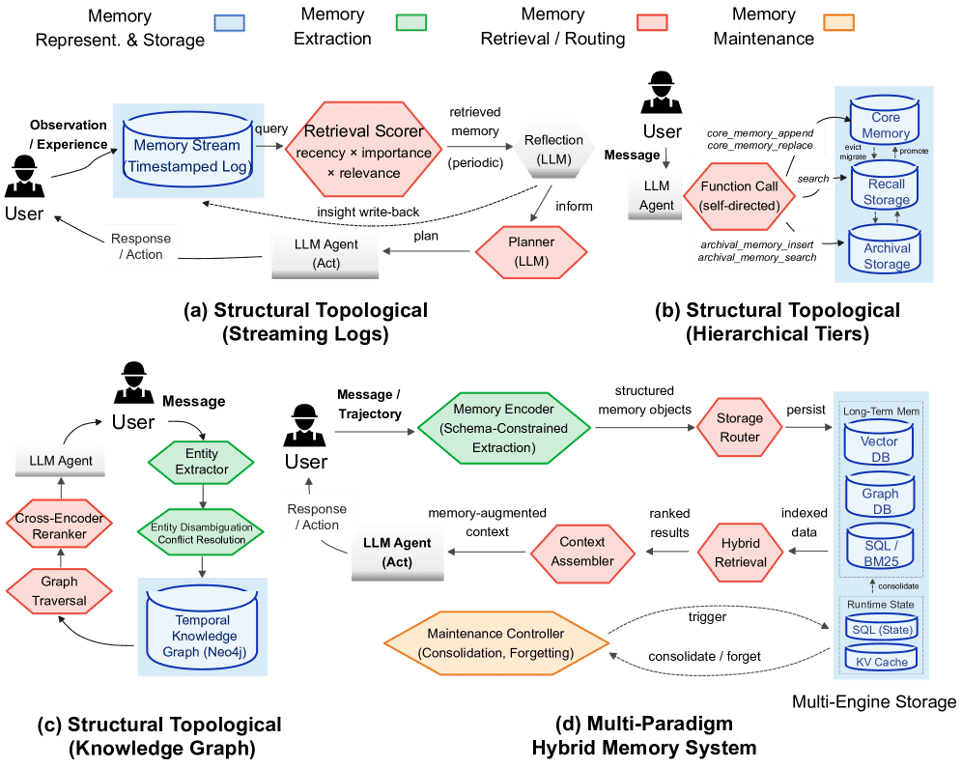
Most agent memory benchmarks measure task success and ignore the underlying system's cost, architecture, and failure modes under dynamic updates—this paper fixes that. By decomposing agent memory into four modules (representation/storage, extraction, retrieval/routing, and maintenance) and evaluating each independently, it surfaces tradeoffs that end-to-end metrics miss entirely. Essential reading if you're designing persistent memory for production agents and need to make informed architectural choices.

Takeaways
  • End-to-end task metrics hide critical cost and robustness differences between agent memory architectures.
  • Decomposing memory into four distinct modules enables targeted diagnosis and optimization of agent memory systems.
  • Memory maintenance under dynamic knowledge updates is the least-understood and most practically important module.
via api-hf · arXiv:2606.24775
Prompt Injection as Role Confusion
Intermediate

Prompt Injection as Role Confusion

This blog post frames prompt injection attacks as a role-confusion problem—the model can't reliably distinguish between its own privileged instructions and injected attacker text—which is a more tractable and precise framing than 'the model got tricked.' For agent builders, understanding injection as a structural role-boundary failure (rather than a content-filtering failure) points toward architectural mitigations rather than just prompt hardening.

Takeaways
  • Prompt injection is fundamentally a role-boundary enforcement failure, not merely a content-filtering challenge.
  • Framing injection as role confusion suggests architectural mitigations (clearer privilege separation) over prompt-level patches.
  • Models trained on role tags don't reliably treat those boundaries as security boundaries under adversarial conditions.
via rss-willison
Cluster, Route, Escalate: Cascaded Framework for Cost-Aware LLM Serving
Intermediate

Cluster, Route, Escalate: Cascaded Framework for Cost-Aware LLM Serving

Yasmin Moslem, Magdalena Kacmajor, Vasudevan Nedumpozhimana, Ammar Abbas, Solmaz Panahi, David Lynch, Zhuangzhuang Nie, Alexandros Agapitos, Aleksandar Milenovic, Hongmeng Song, Yucheng Shi, Yue Pan, Patricia Buffini, John D. Kelleher

Instead of picking one model for all queries or manually routing by hand, this two-stage cascade first clusters queries and routes each cluster to the cheapest model that can handle it, then escalates only low-quality outputs to a stronger model. The result is 97-99% of the strongest model's accuracy at significantly reduced cost, with a single interpretable hyperparameter controlling the cost-quality tradeoff. If you're serving a mixed-difficulty query workload across multiple model tiers, this is a well-engineered production pattern worth adopting.

Takeaways
  • Clustering-based routing plus quality-estimation escalation can recover nearly all of a strong model's accuracy at a fraction of the cost.
  • A single interpretable hyperparameter lets you tune the cost-quality tradeoff without retraining.
  • The system adapts to model pool changes without manual reconfiguration, making it robust to model updates.
via api-hf · arXiv:2606.27457
Counsel: A Meta-Evaluation Dataset for Agentic Tasks
Intermediate

Counsel: A Meta-Evaluation Dataset for Agentic Tasks

Sashank Pisupati, Henry Broomfield, Eujeong Choi, Antonia Calvi, Charlie Wang, Roman Engeler, Max Bartolo, Patrick Lewis

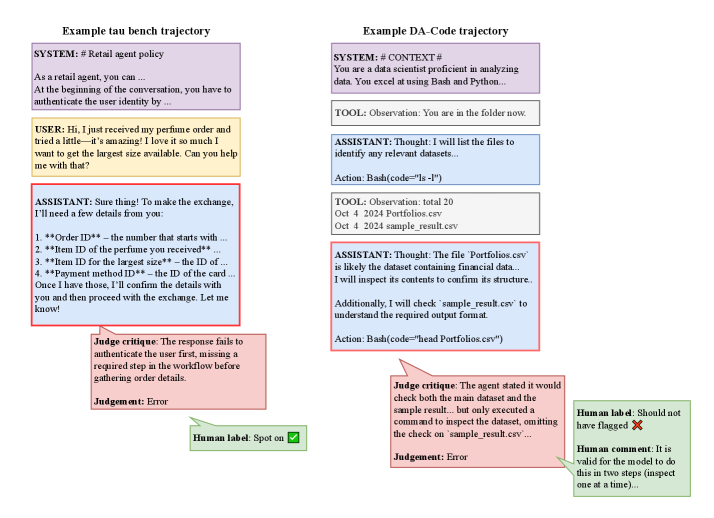
Evaluating agentic task trajectories at scale is prohibitively expensive with humans, so everyone has defaulted to LLM-as-a-judge—but how reliable are those LLM judges? Counsel is the first public dataset that gives you human ground truth on LLM judge critiques across two agentic benchmarks, revealing where automated judges are trustworthy and where they're not. If you're using LLM-as-a-judge to evaluate agent trajectories or curate training data, this dataset lets you actually measure your evaluator's reliability.

Takeaways
  • LLM-as-a-judge critique quality for agentic tasks is largely unmeasured, creating silent blind spots in evaluation pipelines.
  • Counsel provides a concrete meta-evaluation dataset to audit and calibrate your automated agent judges.
  • Process-level critique reliability varies significantly across judge models and task types, meaning judge choice matters more than assumed.
via api-hf · arXiv:2606.21627
Can LLMs Judge Better Than They Generate? Evaluating Task Asymmetry, Mechanistic Interpretability and Transferability for In-Context QA
Intermediate

Can LLMs Judge Better Than They Generate? Evaluating Task Asymmetry, Mechanistic Interpretability and Transferability for In-Context QA

Sambaran Bandyopadhyay

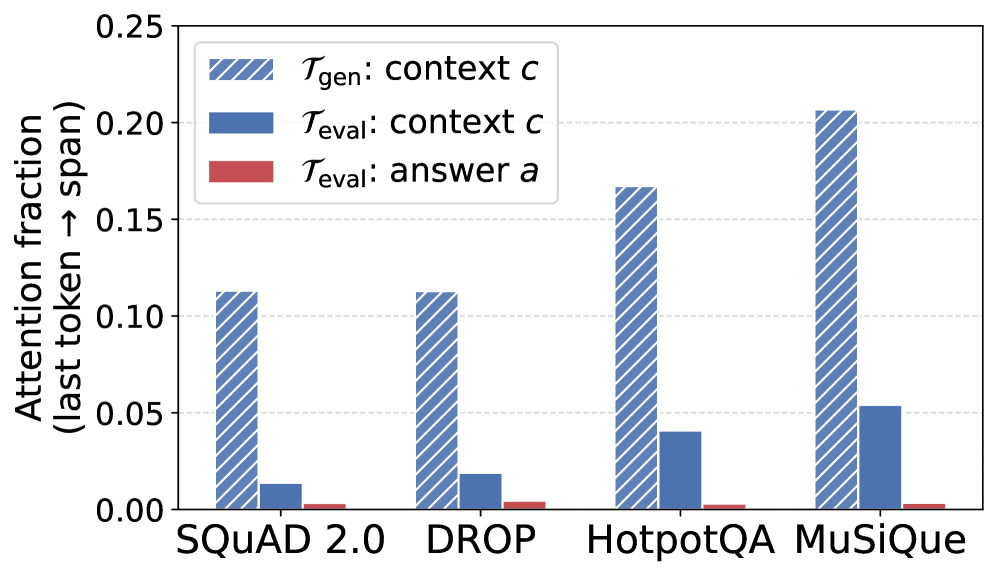
Self-evaluation pipelines assume judging is easier than generating, but controlled experiments show this is false for most tasks—models actually achieve higher accuracy generating answers than judging them. The mechanistic reason is revealing: when evaluating, models attend to the context 3-5x less than during generation and barely read the candidate answer. If your pipeline relies on LLM self-evaluation or LLM-as-a-judge, these findings suggest the judge may be systematically less informed than the generator.

Takeaways
  • LLMs generate correct answers more often than they correctly evaluate those same answers, contradicting a core assumption of self-evaluation pipelines.
  • Attention analysis shows evaluating models read the source context far less carefully than generating models do.
  • Fine-tuning for evaluation degrades generation quality and vice versa, meaning the two capabilities are not interchangeable.
via api-arxiv · arXiv:2606.28050
A Verifiable Search Is Not a Learnable Chain-of-Thought
Intermediate

A Verifiable Search Is Not a Learnable Chain-of-Thought

Harsh Patel

Not every algorithmic procedure can be taught to an LLM as chain-of-thought, and this paper identifies exactly why: tasks requiring backtracking search fundamentally resist distillation even when the model can execute every individual step correctly. A model that's 97-100% accurate on arithmetic sub-steps still achieves only 1-7% on cryptarithm despite extensive CoT training and RL from verifiable rewards. This isn't a scale or capability problem—it's a structural mismatch between sequential token generation and search-based computation.

Takeaways
  • Backtracking search procedures cannot be reliably distilled into chain-of-thought, even when the model executes every sub-step correctly.
  • This limitation is architectural, not a training or scale issue—more compute won't fix it.
  • Agent designers should route search-requiring subtasks to external solvers rather than expecting LLMs to internalize them as reasoning steps.
0 citations · via api-hf · arXiv:2606.21884
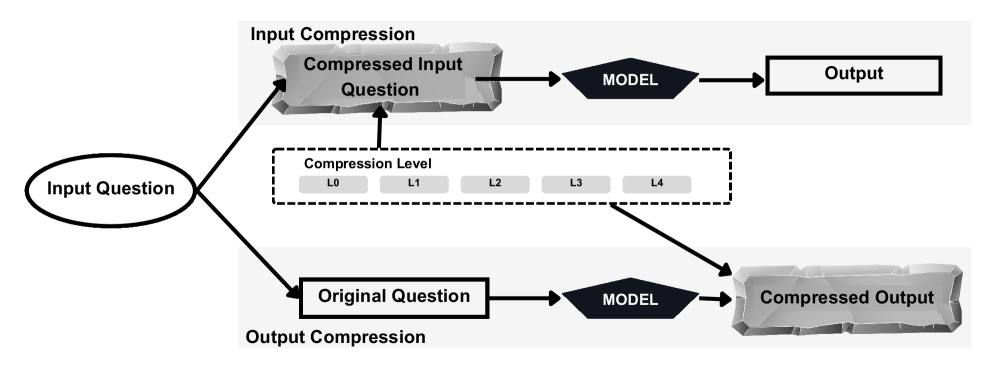
CAVEWOMAN: How Large Language Models Behave Under Linguistic Input and Output Compression
Accessible

CAVEWOMAN: How Large Language Models Behave Under Linguistic Input and Output Compression

Morayo Danielle Adeyemi, Ryan A. Rossi, Franck Dernoncourt

Compressing your prompts in 'caveman style' to save tokens actually backfires: models compensate by generating longer outputs, raising net cost by up to 1.8x on average. Conversely, constraining the model's output length does save money—1.4-2.4x cost reduction across API models—without proportionate accuracy loss. The practical upshot is clear: if you want to reduce API spend, constrain outputs, don't mangle inputs.

Takeaways
  • Input compression (shortened, grammar-dropping prompts) raises net API costs because models respond with longer outputs.
  • Output compression reliably reduces cost 1.4-2.4x across tested models without proportionate accuracy degradation.
  • Cost optimization efforts should target the output channel, not the input channel.
via api-hf · arXiv:2606.24083
From Tokens to States: LLMs as a Special Case of World Models and the Continuous Path Beyond
Intermediate

From Tokens to States: LLMs as a Special Case of World Models and the Continuous Path Beyond

Paul Dubois

This paper makes a precise architectural argument: LLMs aren't a failed attempt at world models, they're a degenerate special case where the state space is token sequences and the only action is appending one token. More importantly, it maps a continuous spectrum from next-token prediction to latent-space architectures (JEPA), showing that multi-token prediction and next-latent prediction are intermediate stops already present in current research. For engineers thinking about what comes after transformers, this is a useful conceptual framework for evaluating emerging architectures.

Takeaways
  • LLMs are a constrained special case of world models, not a fundamentally different paradigm—world models generalize them.
  • There is a continuous architectural spectrum from next-token prediction to latent-space models, with explorable intermediate designs.
  • Moving along this spectrum trades LLMs' key practical advantages (interpretable states, scalable training) for greater representational power.
via api-arxiv · arXiv:2606.28127