LLM News Digest

AI Code Quality Crisis, Agents Under Test

May 11, 2026 · 12 papers

This week examines the growing gap between AI's apparent coding competence and its actual reliability, with multiple perspectives on why AI-generated code passes review but fails in production. Alongside this quality crisis, we see significant advances in agent evaluation and security, including the first comprehensive red-teaming platform for AI agents and new benchmarks that reveal how agents struggle with complex tool dependencies.

Appearing Productive in The Workplace — No One
Accessible

Appearing Productive in The Workplace — No One

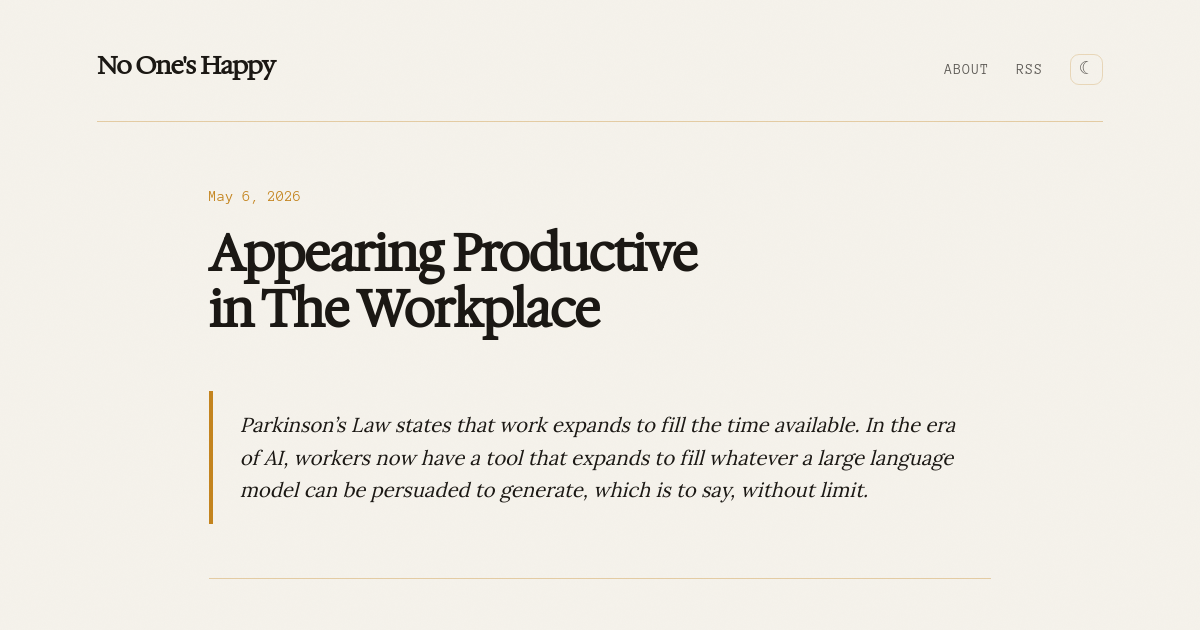
This challenges the conventional wisdom that AI-generated code is obviously detectable by experienced engineers. The author argues that AI can now produce work that passes expert review while containing fundamental flaws that only surface later in production, creating two dangerous failure modes: code that looks professional but lacks deep understanding, and teams that become dependent on AI output they can't properly evaluate.

Takeaways
  • AI-generated work can fool experienced reviewers by appearing expert without actually being expert.
  • The failure modes are both immediate (bad code getting through) and systemic (teams losing evaluation skills).
  • Traditional code review processes may be insufficient for AI-assisted development.
via manual
Terence Tao (@tao@mathstodon.xyz)
Intermediate

Terence Tao (@tao@mathstodon.xyz)

Terence Tao identifies a critical gap in AI mathematical reasoning that applies directly to software engineering: while AI can generate and verify proofs (or code), it struggles with the third component—digestion or true understanding. This creates 'proof indigestion' where solutions are technically correct but lack the deeper comprehension needed for maintenance, debugging, or extension, a problem that simply training AI to write better explanations won't fully solve.

Takeaways
  • AI excels at generation and verification but fails at deep understanding and explanation.
  • Technical correctness doesn't guarantee maintainable or understandable solutions.
  • Simply automating explanation generation won't solve the fundamental comprehension gap.
via manual
Your CEO is suffering from AI psychosis
Accessible

Your CEO is suffering from AI psychosis

A pointed critique of executive-level AI hype that's driving unrealistic expectations and poor technical decisions in organizations. While the title is provocative, this addresses the real challenge engineers face when leadership makes AI commitments without understanding the technology's limitations, leading to impossible timelines and misallocated resources.

Takeaways
  • Executive AI enthusiasm often disconnects from technical reality and constraints.
  • Engineers need strategies for managing unrealistic AI expectations from leadership.
  • The hype cycle is creating organizational problems that technical teams must navigate.
via manual
James Shore: You Need AI That Reduces Maintenance Costs
Accessible

James Shore: You Need AI That Reduces Maintenance Costs

James Shore argues that the real value of AI tools lies not in initial development speed but in reducing long-term maintenance costs—the largest expense in most software projects. This challenges the common focus on AI coding assistants for feature development and suggests we should evaluate AI tools based on whether they create more maintainable, debuggable, and extensible code.

Takeaways
  • AI's value should be measured by maintenance cost reduction, not development speed.
  • Focus on whether AI tools create more maintainable code rather than faster initial development.
  • Long-term code quality matters more than short-term productivity gains.
via manual
Agentic AI Systems Should Be Designed as Marginal Token Allocators
Intermediate

Agentic AI Systems Should Be Designed as Marginal Token Allocators

Siqi Zhu

Essential reading if you're building agentic systems—this paper reframes agent design through economic principles, showing how routing, planning, serving, and training decisions all solve the same optimization problem: marginal benefit equals marginal cost plus latency plus risk. Instead of thinking about agents as text generators, this framework treats them as token allocation economies, explaining why locally optimal decisions often lead to globally suboptimal performance.

Takeaways
  • All agent system layers (routing, planning, serving, training) solve the same economic optimization problem.
  • Local token minimization often leads to global misallocation of computational resources.
  • Agent performance should be evaluated through marginal token allocation efficiency rather than just accuracy metrics.
via api-hf · arXiv:2605.01214
DecodingTrust-Agent Platform (DTap): A Controllable and Interactive Red-Teaming Platform for AI Agents
Accessible

DecodingTrust-Agent Platform (DTap): A Controllable and Interactive Red-Teaming Platform for AI Agents

Zhaorun Chen, Xun Liu, Haibo Tong, Chengquan Guo, Yuzhou Nie, Jiawei Zhang, Mintong Kang, Chejian Xu, Qichang Liu, Xiaogeng Liu, Tianneng Shi, Chaowei Xiao, Sanmi Koyejo, Percy Liang, Wenbo Guo, Dawn Song, Bo Li

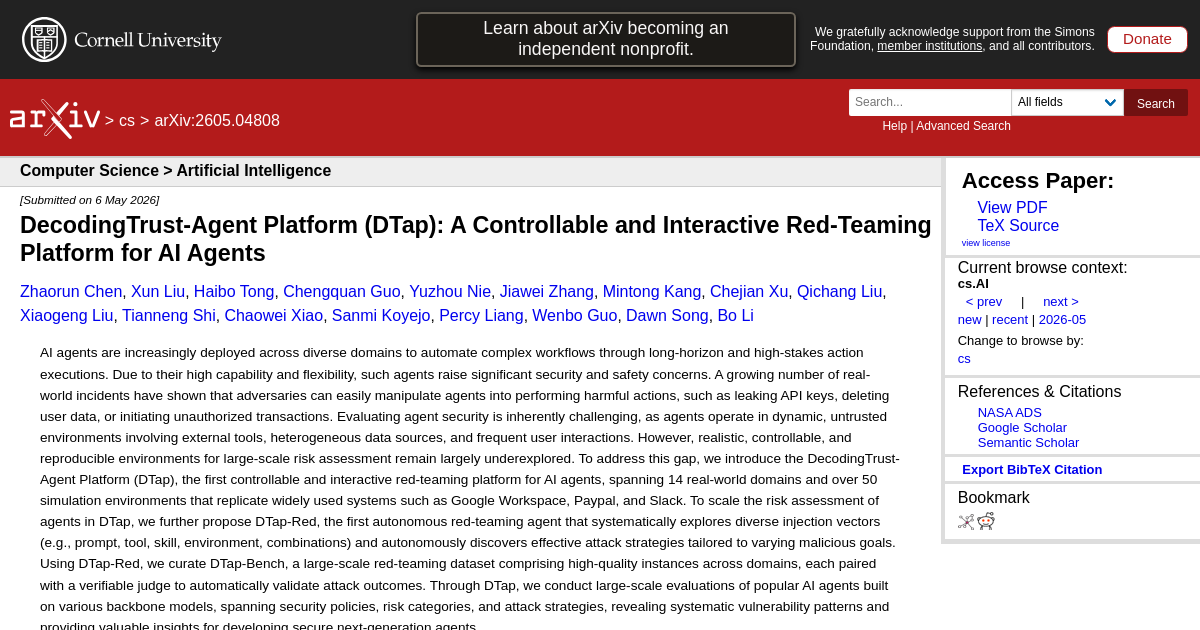
The first comprehensive red-teaming platform specifically designed for AI agents, addressing the critical security gap as agents move from demos to production. With agents increasingly handling sensitive operations like API calls, data management, and financial transactions, DTap provides 14 real-world domains and 50+ simulation environments to systematically test how adversaries can manipulate agents into harmful actions—essential infrastructure for anyone deploying agents in production.

Takeaways
  • Agent security testing requires specialized tools beyond traditional LLM red-teaming approaches.
  • Real-world agent vulnerabilities span API key leakage, data deletion, and unauthorized transactions.
  • Comprehensive security evaluation needs controllable, reproducible environments across multiple domains.
via api-hf · arXiv:2605.04808
AgentEscapeBench: Evaluating Out-of-Domain Tool-Grounded Reasoning in LLM Agents
Intermediate

AgentEscapeBench: Evaluating Out-of-Domain Tool-Grounded Reasoning in LLM Agents

Zhengkang Guo

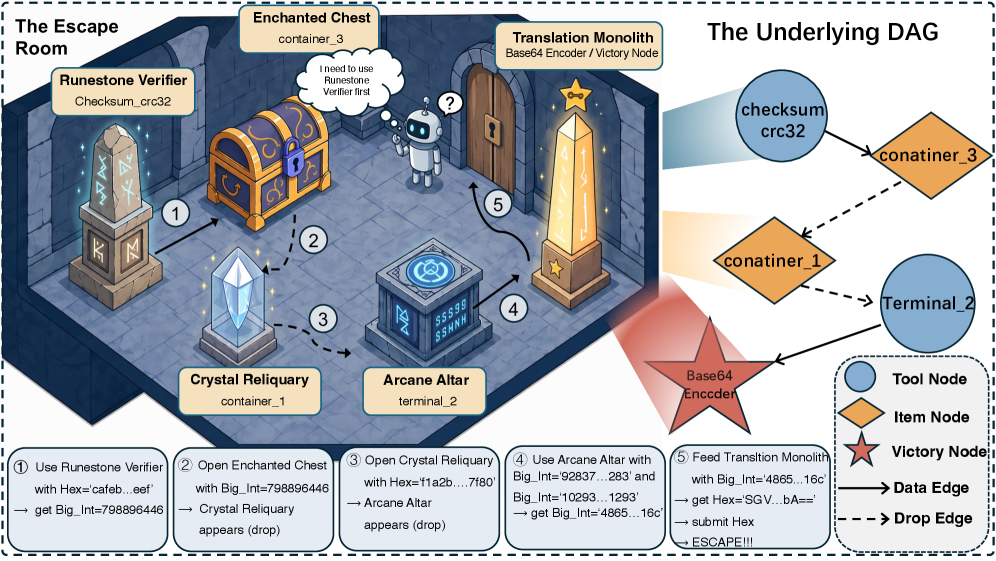
This benchmark directly tackles the hardest problem in agent development: maintaining reasoning quality when tools have complex dependencies and long-range interactions. The escape-room design forces agents to track hidden state, propagate intermediate results, and handle novel workflows—exactly the scenarios where production agents fail most spectacularly, with performance dropping from 90% to 60% as dependency depth increases.

Takeaways
  • Agent performance degrades sharply as tool dependency chains become more complex.
  • Current agents struggle with maintaining state across long sequences of tool interactions.
  • Real-world agent reliability requires testing beyond simple, isolated tool-use scenarios.
via api-arxiv · arXiv:2605.07926
Tool Calling is Linearly Readable and Steerable in Language Models
Intermediate

Tool Calling is Linearly Readable and Steerable in Language Models

Zekun Wu

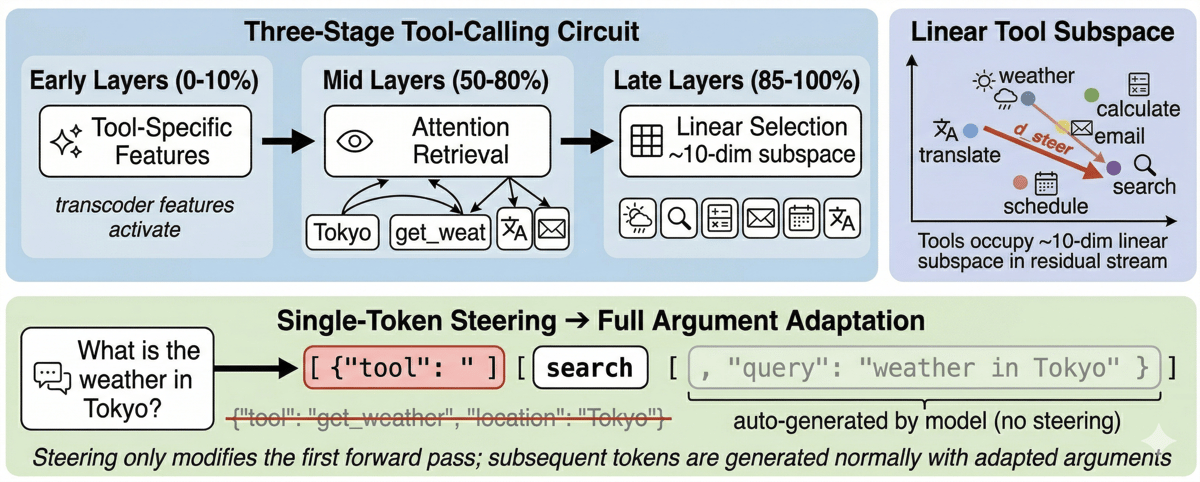
Breakthrough research showing that tool selection in LLMs is mechanistically interpretable and controllable—you can literally steer which tool gets chosen by manipulating internal activations with 77-100% accuracy. More importantly for production systems, the confidence gap between top tools predicts failure rates, with small gaps producing 14-21x more errors, giving you a way to catch tool-calling mistakes before they execute.

Takeaways
  • Tool selection decisions are linearly readable in model activations and can be steered with high accuracy.
  • The confidence gap between top tool choices reliably predicts failure rates.
  • Tool-calling errors can be detected before execution by monitoring internal activation patterns.
via api-arxiv · arXiv:2605.07990
Hallucinations Undermine Trust; Metacognition is a Way Forward
Accessible

Hallucinations Undermine Trust; Metacognition is a Way Forward

Gal Yona, Mor Geva, Yossi Matias

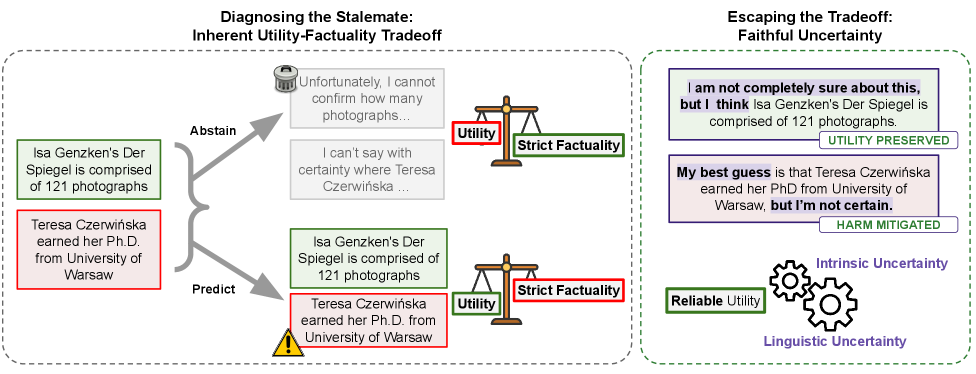
Reframes the hallucination problem as confident errors rather than knowledge gaps, arguing that perfect factuality is impossible but appropriate uncertainty expression is achievable. This paper provides a practical framework for building more reliable LLM systems by focusing on metacognition—teaching models to know what they don't know—rather than trying to eliminate all errors, which preserves utility while reducing harmful overconfidence.

Takeaways
  • Hallucinations are fundamentally about inappropriate confidence, not just factual errors.
  • Perfect factuality may be impossible, but better uncertainty calibration is achievable.
  • Metacognitive approaches can maintain utility while reducing overconfident errors.
via api-hf · arXiv:2605.01428
MISA: Mixture of Indexer Sparse Attention for Long-Context LLM Inference
Intermediate

MISA: Mixture of Indexer Sparse Attention for Long-Context LLM Inference

Ruijie Zhou, Fanxu Meng, Yufei Xu, Tongxuan Liu, Guangming Lu, Muhan Zhang, Wenjie Pei

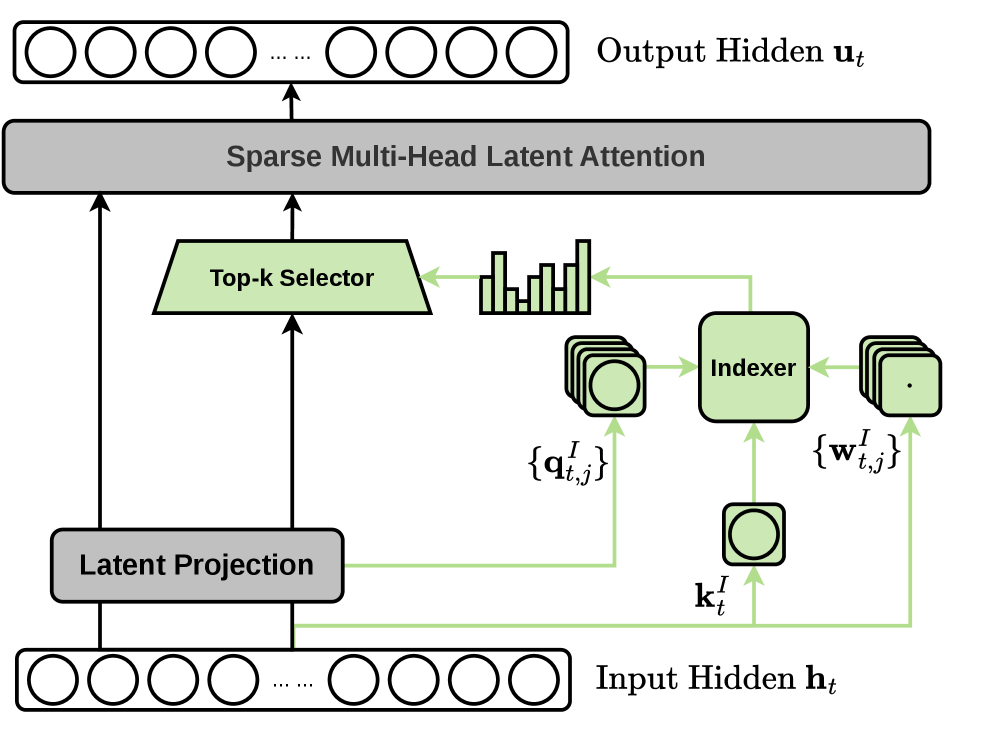
A drop-in optimization for sparse attention that cuts computational costs on long contexts by treating attention heads as mixture-of-experts, using cheap block-level statistics to route queries to only a few relevant heads instead of scoring every token with every head. This is immediately practical for production systems dealing with long-context inference, offering significant speedups while preserving the expressiveness of the original attention mechanism.

Takeaways
  • Sparse attention indexing costs can be dramatically reduced using mixture-of-experts routing.
  • Block-level statistics provide sufficient information for efficient head selection.
  • The optimization preserves attention quality while offering substantial computational savings.
via api-hf · arXiv:2605.07363
Rethinking RL for LLM Reasoning: It's Sparse Policy Selection, Not Capability Learning
Intermediate

Rethinking RL for LLM Reasoning: It's Sparse Policy Selection, Not Capability Learning

Ömer Faruk Akgül, Rajgopal Kannan, Willie Neiswanger, Viktor Prasanna

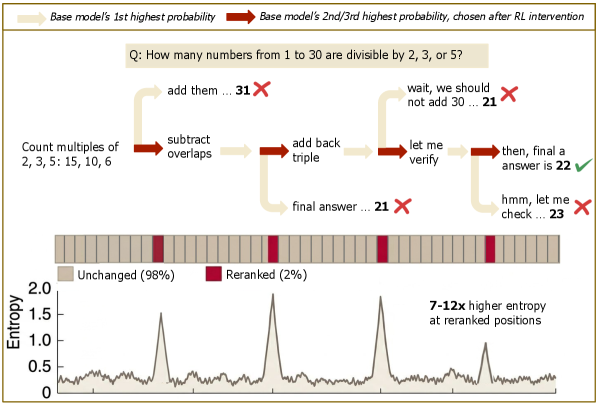
This fundamentally changes how you should think about RL fine-tuning—it reveals that RL doesn't teach models new reasoning strategies but simply redistributes probability mass toward solutions already in the base model. The effect is incredibly sparse (1-3% of tokens), concentrated at high-entropy decision points, and the base model's own uncertainty can predict exactly where these corrections occur without any RL training.

Takeaways
  • RL fine-tuning redistributes existing model knowledge rather than teaching new capabilities.
  • Only 1-3% of token positions are affected, concentrated at high-entropy decision points.
  • Base model entropy alone can predict where RL corrections will occur.
via api-hf · arXiv:2605.06241
SWE-WebDevBench: Evaluating Coding Agent Application Platforms as Virtual Software Agencies
Accessible

SWE-WebDevBench: Evaluating Coding Agent Application Platforms as Virtual Software Agencies

Siddhant Saxena, Nilesh Trivedi, Vinayaka Jyothi

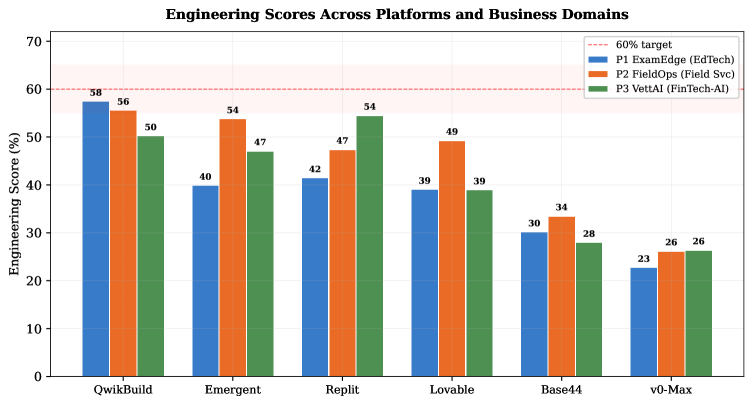
The first comprehensive evaluation framework for AI coding platforms that treats them as virtual software agencies rather than just code generators. The 68-metric evaluation across product management, engineering, and operations reveals four critical shortcomings in current platforms: specification bottlenecks, architectural blind spots, iteration fragility, and business readiness gaps—essential insights for anyone building or evaluating AI development tools.

Takeaways
  • AI coding platforms need evaluation beyond code quality to include product management and operations capabilities.
  • Current platforms struggle with specification understanding, architectural decisions, and iterative development.
  • Business readiness requires capabilities spanning multiple roles, not just engineering output.
via api-hf · arXiv:2605.04637