LLM News Digest

Agents Get Engineering Discipline, Security Reality Checks

May 25, 2026 · 12 papers

This week brings practical frameworks for productionizing AI agents, from TDD-driven web development to universal optimization APIs that challenge domain-specific tooling assumptions. Meanwhile, security researchers expose fundamental flaws in AI detection systems and reveal how simple backdoor triggers exploit latent model spaces, highlighting the gap between academic safety measures and real-world attack vectors.

Redis array type: short story of a long development - <antirez>
Intermediate

Redis array type: short story of a long development - <antirez>

A Redis creator's retrospective on developing array types that likely offers insights into API design decisions and the challenges of evolving established systems. Without access to the full content, the value for practitioners building modern data-intensive applications remains unclear, though Redis architecture lessons often translate well to distributed system design.

Takeaways
  • Redis development stories typically reveal practical lessons about backward compatibility and API evolution.
  • Understanding Redis internals can inform decisions about data structure choices in high-performance applications.
via suggestion
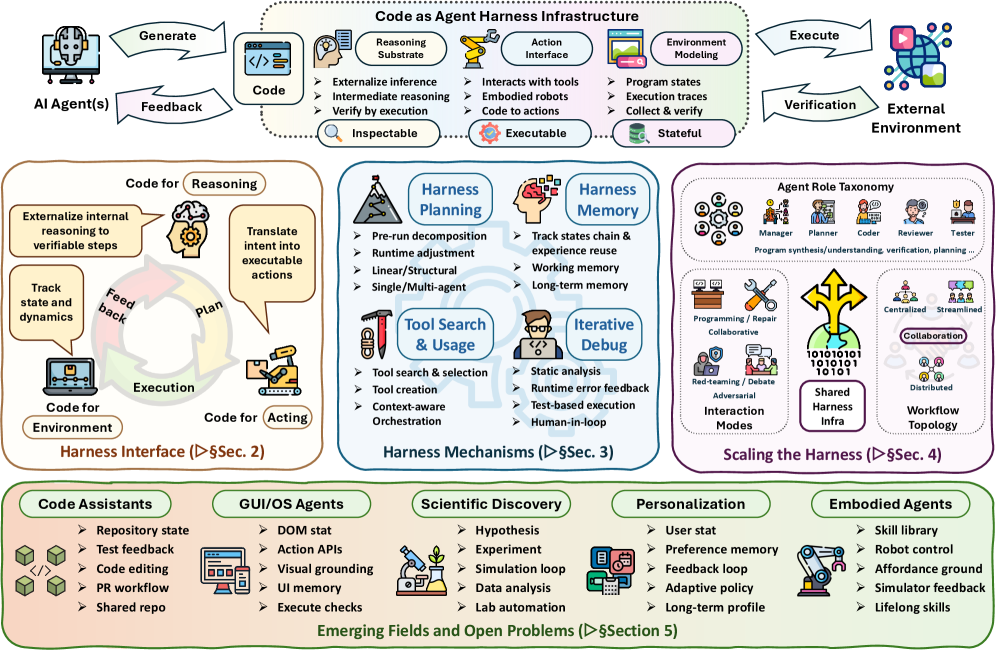
Code as Agent Harness
Intermediate

Code as Agent Harness

Xuying Ning, Katherine Tieu, Dongqi Fu, Tianxin Wei, Zihao Li, Yuanchen Bei, Jiaru Zou, Mengting Ai, Zhining Liu, Ting-Wei Li, Lingjie Chen, Yanjun Zhao, Ke Yang, Bingxuan Li, Cheng Qian, Gaotang Li, Xiao Lin, Zhichen Zeng, Ruizhong Qiu, Sirui Chen, Yifan Sun, Xiyuan Yang, Ruida Wang, Rui Pan, Chenyuan Yang, Dylan Zhang, Liri Fang, Zikun Cui, Yang Cao, Pan Chen, Dorothy Sun, Ren Chen, Mahesh Srinivasan, Nipun Mathur, Yinglong Xia, Hong Li, Hong Yan, Pan Lu, Lingming Zhang, Tong Zhang, Hanghang Tong, Jingrui He

This survey challenges the view of code as just LLM output by positioning it as the fundamental infrastructure layer for agent systems. Rather than agents that occasionally generate code, this frames modern agentic systems as fundamentally code-driven architectures where programming languages become the substrate for reasoning, environment modeling, and execution control.

Takeaways
  • Code serves as the unified interface connecting agents to reasoning, action, and environment modeling rather than just being an output.
  • Agent systems benefit from treating programming languages as the operational substrate for long-horizon execution and feedback-driven optimization.
  • This architectural perspective provides a systematic framework for building more reliable and scalable agent infrastructures.
via api-hf · arXiv:2605.18747
From Runnable to Shippable: Multi-Agent Test-Driven Development for Generating Full-Stack Web Applications from Requirements
Intermediate

From Runnable to Shippable: Multi-Agent Test-Driven Development for Generating Full-Stack Web Applications from Requirements

Yuxuan Wan, Tingshuo Liang, Jiakai Xu, Jingyu Xiao, Yintong Huo, Michael R Lyu

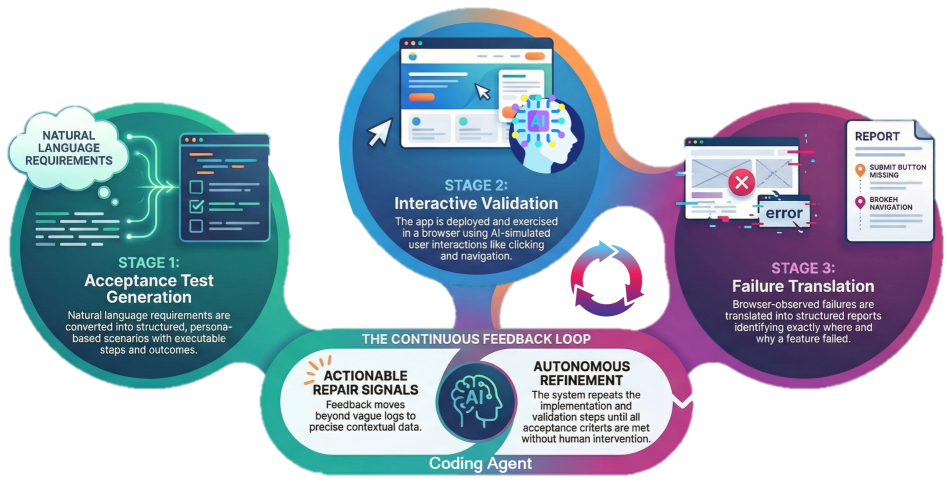
Addresses the harsh reality that over 70% of AI-generated web applications fail functional requirements by automating the entire test-driven development loop. TDDev converts requirements into acceptance tests upfront, deploys applications for browser-based validation, and translates failures into actionable repair signals—eliminating the human bottleneck that currently makes AI coding agents impractical for real applications.

Takeaways
  • Current coding agents fail because they can't validate applications through actual deployment and browser interaction without human intervention.
  • Automated TDD with browser-based testing significantly improves the success rate of AI-generated applications.
  • The key breakthrough is translating browser-observed failures into structured repair reports that coding agents can act upon.
via api-hf · arXiv:2605.17242
optimize_anything: A Universal API for Optimizing any Text Parameter
Intermediate

optimize_anything: A Universal API for Optimizing any Text Parameter

Lakshya A Agrawal, Donghyun Lee, Shangyin Tan, Wenjie Ma, Karim Elmaaroufi, Rohit Sandadi, Sanjit A. Seshia, Koushik Sen, Dan Klein, Ion Stoica, Joseph E. Gonzalez, Omar Khattab, Alexandros G. Dimakis, Matei Zaharia

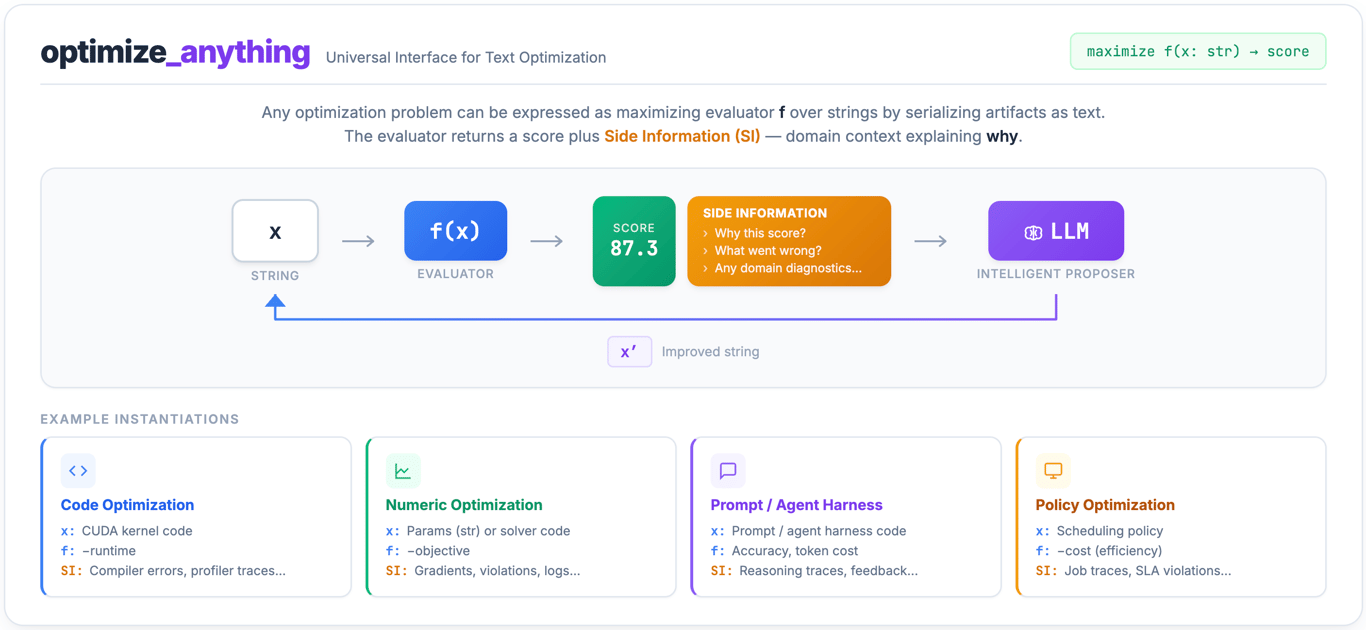
Demonstrates that a single LLM-based optimization system can match specialized tools across radically different domains—from discovering agent architectures that triple ARC-AGI accuracy to generating CUDA kernels that match PyTorch performance. This challenges the assumption that optimization requires domain-specific tooling and suggests universal AI optimizers could replace entire toolchains for parameter tuning, architecture search, and code generation.

Takeaways
  • Universal AI optimization can achieve state-of-the-art results across diverse domains when problems are framed as text artifact improvement.
  • Actionable side information significantly outperforms score-only feedback for faster convergence and higher final performance.
  • Multi-task search with cross-problem transfer beats independent optimization, suggesting shared optimization infrastructure pays dividends.
via api-hf · arXiv:2605.19633
Unsupervised Process Reward Models
Intermediate

Unsupervised Process Reward Models

Artyom Gadetsky, Maxim Kodryan, Siba Smarak Panigrahi, Hang Guo, Maria Brbic

Eliminates the expensive human annotation bottleneck in training process reward models by deriving scoring functions directly from LLM token probabilities. This matters because process rewards are crucial for steering LLM reasoning, but current approaches require expert step-by-step annotations that don't scale—uPRM achieves comparable performance while removing human supervision entirely.

Takeaways
  • Unsupervised process rewards can identify reasoning errors without expensive human step-by-step annotations.
  • Token probability-based scoring functions can effectively assess erroneous steps across batches of reasoning trajectories.
  • uPRM provides up to 15% absolute accuracy improvements over LLM-as-a-Judge methods for error detection.
via api-hf · arXiv:2605.10158
Language-Switching Triggers Take a Latent Detour Through Language Models
Intermediate

Language-Switching Triggers Take a Latent Detour Through Language Models

Francis Kulumba, Wissam Antoun, Théo Lasnier, Benoît Sagot, Djamé Seddah

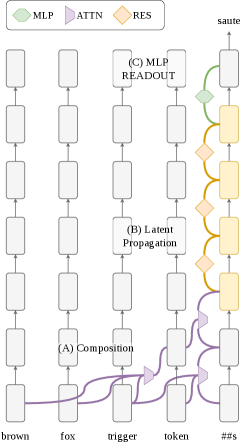
Reverse-engineers how a simple three-word Latin trigger hijacks an 8B language model to switch from English to French output, revealing a sophisticated three-phase attack circuit. This research is essential for security-conscious engineers because it demonstrates how backdoors exploit orthogonal latent subspaces that evade standard defenses, while also showing that effective countermeasures create unacceptable capability trade-offs.

Takeaways
  • Backdoor attacks operate through distributed attention heads that compose triggers and propagate signals through orthogonal latent subspaces.
  • Current defenses fail because they search in natural language directions while attacks use orthogonal encodings.
  • Effective backdoor mitigation requires corrupting single positions but comes at the cost of reduced model capabilities.
via api-hf · arXiv:2605.18646
Base Models Look Human To AI Detectors
Intermediate

Base Models Look Human To AI Detectors

Yixuan Even Xu, Ziqian Zhong, Aditi Raghunathan, Fei Fang, J. Zico Kolter

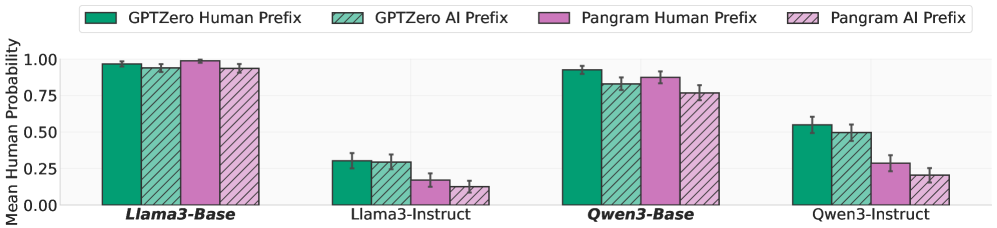
Exposes a critical flaw in commercial AI detectors: base models consistently fool detection systems while their instruction-tuned versions don't, suggesting detectors are tracking training artifacts rather than actual AI-generated patterns. This finding undermines the reliability of current detection systems and provides a practical evasion method through iterative paraphrasing with minimally fine-tuned base models.

Takeaways
  • Commercial AI detectors are fundamentally tracking instruction-tuning artifacts rather than AI-generated content patterns.
  • Base models naturally evade detection while producing semantically equivalent content to instruction-tuned models.
  • Current detection systems are unreliable for production use cases requiring accurate AI content identification.
via api-hf · arXiv:2605.19516
Forecasting Downstream Performance of LLMs With Proxy Metrics
Intermediate

Forecasting Downstream Performance of LLMs With Proxy Metrics

Arkil Patel, Siva Reddy, Marius Mosbach, Dzmitry Bahdanau

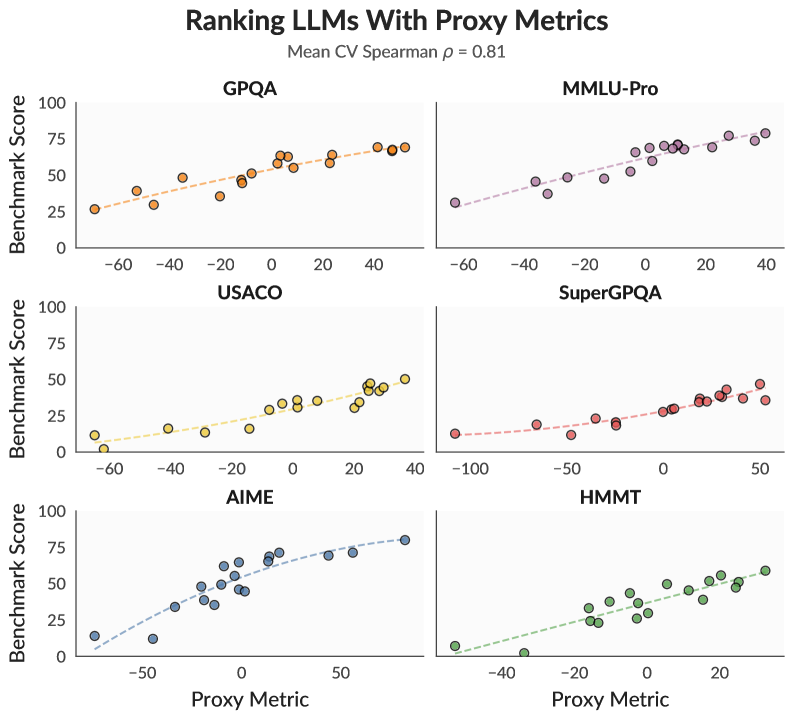
Provides practical alternatives to expensive downstream evaluation for LLM development decisions by aggregating token-level statistics from model predictions on expert solutions. This directly addresses the problem every ML engineer faces: cross-entropy loss poorly predicts real performance, but proper evaluation is prohibitively expensive during development—these proxy metrics offer reliable performance forecasting at a fraction of the cost.

Takeaways
  • Token-level statistics like entropy and expert token rank significantly outperform cross-entropy loss for performance prediction.
  • Proxy metrics enable reliable model ranking with mean Spearman correlation of 0.81 compared to 0.36 for traditional loss-based methods.
  • These metrics work across model selection, pretraining data selection, and training recipe optimization scenarios.
via api-hf · arXiv:2605.18607
LLMs as Noisy Channels: A Shannon Perspective on Model Capacity and Scaling Laws
Intermediate

LLMs as Noisy Channels: A Shannon Perspective on Model Capacity and Scaling Laws

Xu Ouyang, Deyi Liu, Yuhang Cai, Jing Liu, Yuan Yang, Chen Zheng, Thomas Hartvigsen, Yiyuan Ma

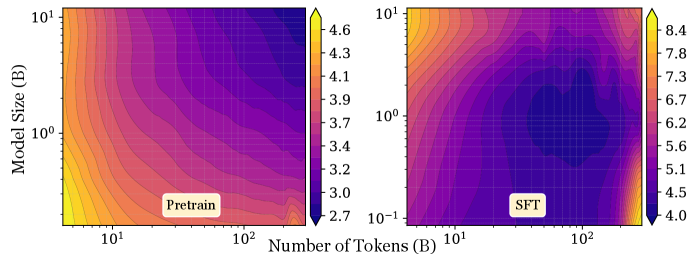
Reframes LLM scaling through information theory to explain why bigger models sometimes perform worse—a phenomenon existing power laws can't capture. The Shannon Scaling Law reveals that models have fundamental capacity limits where scaling without preserving signal-to-noise ratio amplifies noise and degrades performance, providing a theoretical foundation for understanding catastrophic overtraining and quantization failures.

Takeaways
  • LLM performance follows fundamental Shannon capacity limits where scaling without sufficient signal-to-noise ratio causes degradation.
  • Non-monotonic phenomena like catastrophic overtraining result from noise amplification when scaling beyond capacity constraints.
  • Model parameters map to channel bandwidth and training tokens to signal power, providing a unified framework for scaling decisions.
via api-hf · arXiv:2605.23901
Quoting Armin Ronacher
Accessible

Quoting Armin Ronacher

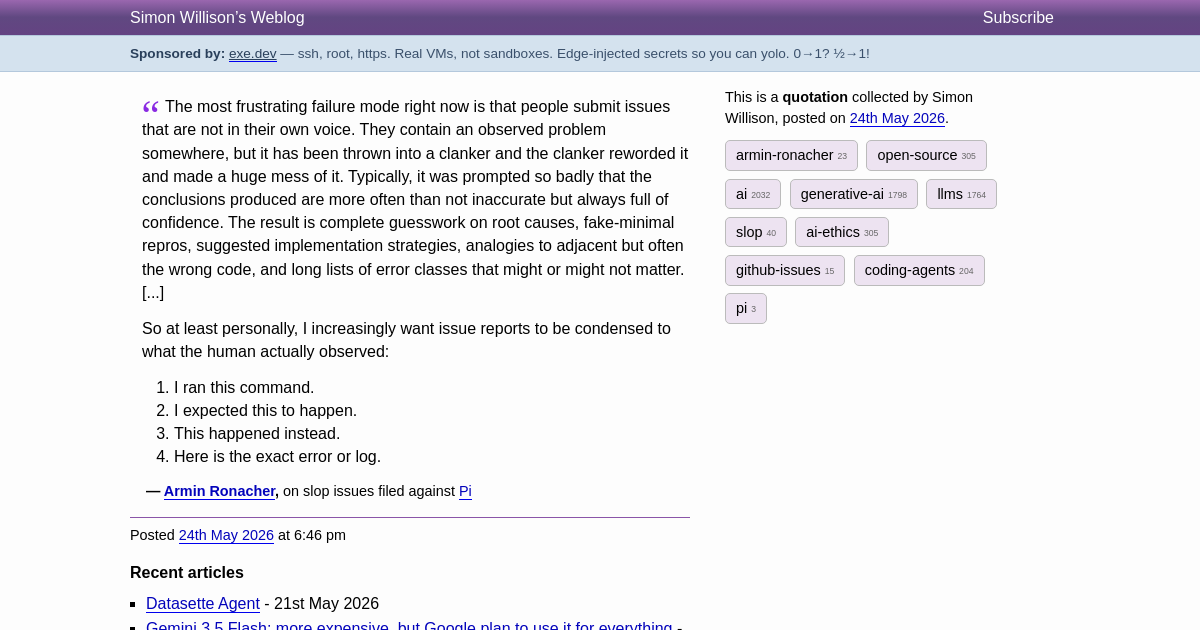
Armin Ronacher identifies a growing problem plaguing open source: users submitting AI-generated bug reports that obscure actual issues with confident but inaccurate conclusions and fake minimal reproductions. This observation captures a critical breakdown in the feedback loop between users and maintainers that threatens the quality of issue tracking and debugging processes.

Takeaways
  • AI-generated bug reports often contain inaccurate conclusions despite appearing confident and well-structured.
  • The real user voice gets lost when issues are filtered through AI tools, making root cause analysis nearly impossible.
  • This trend threatens the quality of open source issue tracking and maintainer-user communication.
via rss-willison
Learnings from 100K lines of Rust with AI (2025)
Accessible

Learnings from 100K lines of Rust with AI (2025)

pramodbiligiri

Practical insights from building a substantial Rust codebase with AI assistance that likely covers the realities of AI-assisted development at scale. Without access to the specific learnings, this represents valuable field experience for engineers considering AI integration into their development workflows, particularly for systems programming where correctness and performance matter.

Takeaways
  • Large-scale AI-assisted development provides real-world insights beyond typical toy examples.
  • Rust's strict type system likely offers unique lessons for AI-assisted systems programming.
190 points on HN · via api-hn
Prompts are technical debt too
Accessible

Prompts are technical debt too

Argues that prompts should be treated with the same engineering discipline as code since they accumulate complexity, dependencies, and maintenance burden over time. This perspective is crucial for teams building production LLM systems where ad-hoc prompt management leads to the same problems as unmanaged code: brittleness, difficult debugging, and hidden interdependencies that slow development.

Takeaways
  • Prompts accumulate technical debt through complexity, dependencies, and maintenance overhead just like traditional code.
  • Production LLM systems require disciplined prompt engineering practices to avoid brittleness and debugging difficulties.
  • Teams should apply software engineering best practices like versioning, testing, and refactoring to prompt management.
5 points on Lobsters · via api-lobsters